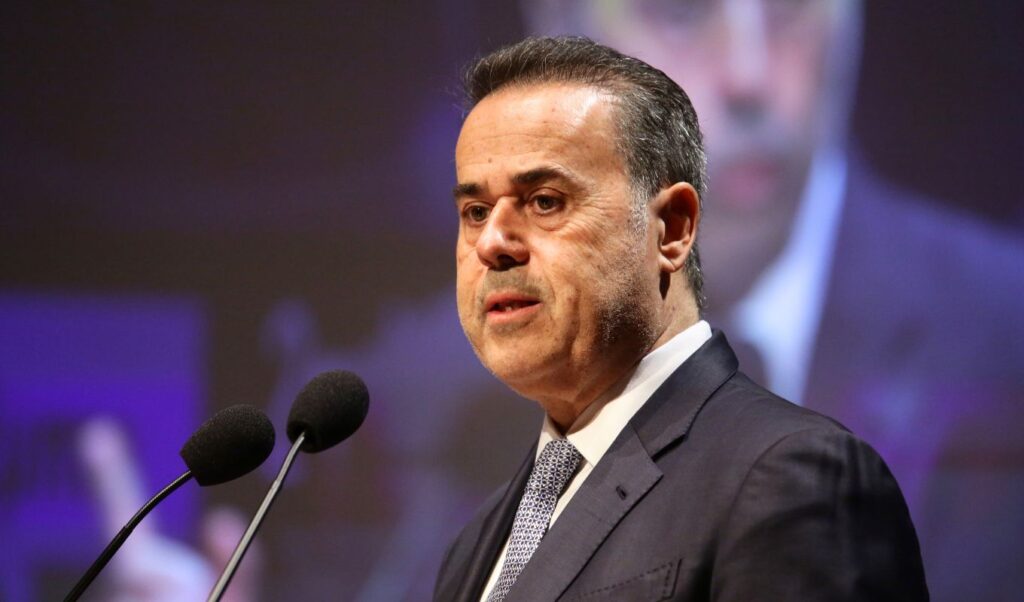
Speaking at a conference organized by the newspaper “Macedonia” in Thessaloniki, Stavros Papastávrou emphasized on Thursday (05/02) in a video interview that Greece is emerging as a key pillar of the new European energy policy, while northern Greece constitutes the “nerve center” of the country’s energy and geopolitical architecture. Specifically, the Minister of Environment and Energy stated: “Northern Greece is a point of energy transfer and a crossroads of infrastructure and investments for the present and future. The FSRU (floating storage and regasification unit for liquefied natural gas) in Alexandroupoli, the DESFA Natural Gas Compression Station in Komotini, the significant renewable energy sources in the region, the Hellenic Energy pipeline, TAP (Trans Adriatic Pipeline), IGB (Greece-Bulgaria Interconnector) and electrical interconnections with Bulgaria, as well as DEI’s Giga Data Center station in Western Macedonia, all these make Northern Greece the energy gateway of Southeast Europe”.
Read: Papastávrou: On February 24 we have joint meeting in USA for Vertical Corridor (Video)
Papastávrou on Vertical Corridor
Referring to the Vertical Corridor, he noted that now, natural gas starting from Greece will reach Central and Eastern Europe, implementing goals for energy diversification and supply security. “And indeed, on our country’s initiative, natural gas coming through Turkey and Turkish Stream is now considered “Russian” from the outset, unless proven otherwise”, he said characteristically and added that all this dynamic is important not only energetically, but also geostrategically.
At the same time, Mr. Papastávrou noted that the benefits of this progress in the energy sector are tangible for citizens. “The new Greece-Bulgaria electrical interconnection, completed in June 2023, allows us to export electricity to the neighboring country. This means that in 2025 Greece was a net electricity exporter, with net exports reaching three terawatt hours. In 2019, our country imported 18% of its electricity needs. Today we save the 575 million euros we spent in 2023″, he noted.
Additionally, he added that DESFA’s compression stations in Komotini and Ampelia Farsala, with investments of 134 and 74 million respectively, create new jobs, strengthen the regional economy and provide strong developmental impetus. “With energy agreements, electricity and natural gas exports, hydrocarbon exploration, if commercially exploitable deposits are found, significant public revenues will be generated, translating into lower energy prices, quality and well-paid jobs and development for all”, he concluded.
“The geopolitical map is changing globally”
Meanwhile, as emphasized from the conference podium by the Deputy Minister of Interior for Macedonia-Thrace affairs, Kostas Gkiouleas, Greece’s gradual but very rapid transformation into an energy hub of European interest constitutes an additional security guarantee. He characteristically noted that “everyone would like to protect the areas through which energy passes”. He added that in a tense situation, with a war in the heart of Europe, Greece emerges as an island of safety and stability.
“The geopolitical map is changing globally. In Europe the changes are very significant and Greece is not simply watching these events as a spectator, but truly participating”, he said and after listing the energy projects underway in Northern Greece, he emphasized that the region acquires very important added value, while the benefits from its energy upgrade are diffused at the national level.
“Not just a transit point, but a strategic partner”
The vertical corridor transforms Greece into a gateway to the Balkans and Ukraine for natural gas and LNG, strengthening its geopolitical position as well as the energy security of the wider region, as emphasized by Athanasios Savvakis, president of “Macedonia Information SA”. “Energy agreements and new infrastructure integrate Greece into the broader regional energy map, where it is not just a transit point, but a strategic partner”, he stressed, while adding that Northern Greece is emerging as an energy hub of European scope.
“The energy transition is not only a technical or geopolitical issue, but a development opportunity for Northern Greece”, he estimated, reminding that in Western Macedonia projects exceeding 2000 megawatts and attracting billions of euros in capital are creating a new production model, while in Thessaloniki, major projects in electricity and gas position the city at the center of the map for the Balkans and Southeast Europe. Overall, conditions are being created for a more stable and competitive energy environment over the next decade – and for Macedonia and Thrace this means new investments, jobs and attraction of more European capital directed toward the green transition.
It is noted that greetings were addressed by Ignatios Kaitezidis, president of the Regional Unit of Central Macedonia Municipalities (PEDKM) and mayor of Pylaia-Hortiatis.