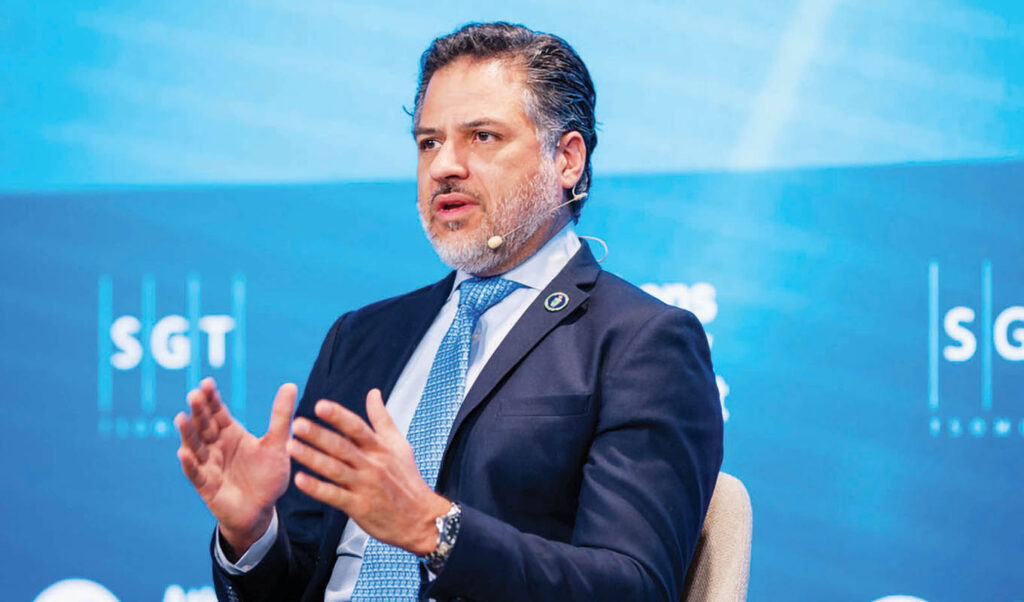
The Vertical Corridor represents the fastest and most realistic route for massive US LNG entry into Central and Eastern Europe, emphasizes US Department of Energy Special Envoy Joshua Volz in an interview with “PARAPOLITIKA” and powergame.gr, on the sidelines of the Athens Energy Summit.
Volz sends a message to Europe, noting that if it is serious about its commitments to complete independence from Russian gas by the end of 2027 and purchasing $750 billion worth of American energy, then it must do everything to support the Vertical Corridor. He also highlights the importance of signing long-term LNG supply contracts and reveals that there are active discussions with American and Greek entities about providing financial support to turn these commercial ambitions into reality.
The main message you sent from Athens was that the natural gas Vertical Corridor must become truly operational as quickly as possible. However, market interest in the last two capacity booking auctions was almost zero, because the route is expensive compared to others, and the European Union has raised regulatory issues. What initiatives are you considering to make the Vertical Corridor commercially viable?
No single stakeholder can make the entire route commercially viable on their own. That’s part of the challenge. The opportunity, on the other hand, is that it requires cooperation and unity of purpose between governments, regulators, operators and investors. That’s why my assigned mission is to focus on the necessary actions to facilitate coordination and alignment of all stakeholders. I think our partners in Brussels have made clear their ambition to replace up to 20% of natural gas consumption in Europe supplied by Russia with alternative sources. Either you’re serious about this goal or you’re not. If you are serious, then you must do everything in your power to facilitate the routes that lead to achieving it. At the same time, Brussels has committed to purchasing $750 billion worth of American energy resources within 36 months of the agreement (note: July 27, 2025), of which about 32-33 months now remain. This is an extremely limited timeframe. So if Brussels takes these two commitments seriously, then they should do everything in their power to facilitate the Vertical Corridor. Because the Vertical Corridor represents the fastest and greatest opportunity for scaling US LNG and natural gas imports to Central and Eastern Europe.
There are many active discussions with American and Greek entities about providing financial support to turn these commercial ambitions into reality
So you’re saying the Vertical Corridor has greater untapped capacity than other gas routes already widely used?
Yes, the northern route is extremely saturated. There are alternative routes, through Lithuania and Croatia, that could play a very important role in regional energy diversification and security. However, Greece offers the ability to achieve this in the fastest way and channel these specific volumes in the shortest possible timeframe. There is significant available capacity in Alexandroupolis, while alternative routes to Central and Eastern Europe are largely already committed. Even if they can be expanded, this will require more time.
Another issue that has been raised in public discourse about the viability of the Vertical Corridor and increasing flows is the need to sign long-term LNG contracts. Something that is also connected to the need to create a second floating LNG terminal (FSRU) in Greece in the future, so that our country’s infrastructure can accommodate the “flood” of American LNG you mentioned…
Yes, this is an absolutely critical factor. Long-term contracts significantly reduce the cost per LNG cargo and are the way to prove to the market and stakeholders throughout the Vertical Corridor that this is not something temporary, but a long-term commitment. And this is the commitment the United States makes to the Hellenic Republic and all our partners in the Vertical Corridor: to be a long-term partner in providing the energy diversification and security necessary to achieve energy stability, supply security and greater price predictability for industry. This is the long-term horizon we pursue and we look forward to continuing to sign such contracts (note: along the lines of what was signed between American Venture Global and ATLANTIC SEE LNG Trade during P-TEC) to support the commercial viability of the Vertical Corridor.
It represents the fastest and greatest opportunity for scaling American LNG and natural gas imports to Central and Eastern Europe
Beyond signing long-term contracts, the issue of financial support for the Vertical Corridor has also been raised, given that the current EU framework does not allow direct subsidies from EU funds for natural gas infrastructure. Recently there has been talk of possible involvement of the state investment bank DFC and/or other entities in the Vertical Corridor project. Where do we stand regarding the prospect of the US putting money on the table?
Dollars and euros are absolutely critical for implementing our energy security goals and creating a new, long-term sustainable product through the Vertical Corridor. The president of the US Export-Import Bank (Ex-Im Bank), John Jovanovic, and DFC CEO Ben Black are absolutely committed to President Trump’s agenda of using development financing tools to enhance US energy exports and support our partners and allies in the region. There are many active discussions with American and Greek entities about providing financial support to turn these commercial ambitions into reality, namely the import of significant additional American LNG through Alexandroupolis, Revithoussa and, overall, through new import infrastructure. I know various options are being considered and there is an excellent American company that manufactures FSRU and related infrastructure that would be interested in participating in future projects. Therefore, where challenges exist, opportunities for increased commercial cooperation and development simultaneously emerge.
Are you optimistic that there will be developments on both these fronts – long-term contracts and possible financial support – in the immediate future?
That is our goal. And I know that my superior, US Energy Secretary Chris Wright, is absolutely committed to initiating these discussions with his counterparts and determining what is required and what is pending, so that these goals are implemented with speed and focus.
Published in Parapolitika