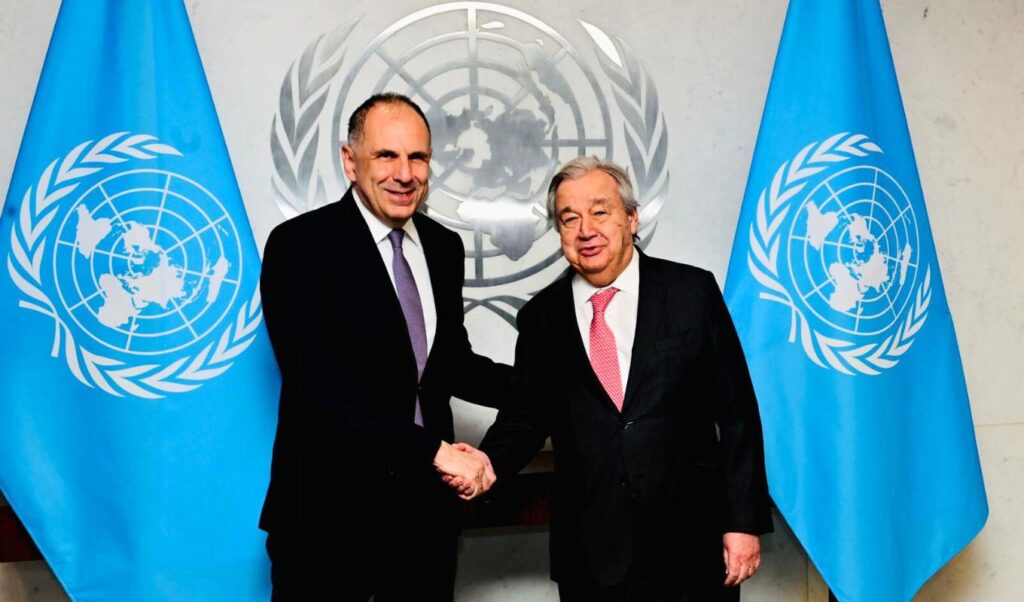
The restart of talks to resolve the Cyprus issue was at the center of the meeting held on Wednesday evening in New York between Foreign Minister Giorgos Gerapetritis and UN Secretary-General António Guterres.
The head of Greek diplomacy -who has prioritized the Cyprus issue since the beginning of his tenure at the Foreign Ministry- explored with the UN Secretary-General the possibilities for restarting official talks and scheduling the next informal expanded meeting (Greece, Republic of Cyprus, Turkey, Northern Cyprus pseudostate, and United Kingdom).
Giorgos Gerapetritis optimistic about achieving Cyprus solution
Giorgos Gerapetritis has expressed optimism several times about achieving a solution to the Cyprus issue. Indeed, about three months ago he argued that the next expanded meeting “will constitute the next step towards reunification,” noting that “Athens, in absolute coordination with Nicosia, has worked systematically to bring the Cyprus issue back to the UN Secretary-General’s agenda after years of inaction.”
Diplomatic sources clarified to parapolitika.gr that over the past two and a half years, the Cyprus issue has entered a period of activity and has become a priority for the Secretary-General. This has been achieved through cooperation between Greek foreign policy and that of the Republic of Cyprus. The tactic followed is gradual steps. The informal expanded meetings began, the first in March in Geneva and the second in July in New York, which essentially restarted talks after Crans-Montana. “The goal of Greek-Cypriot policy is building confidence-building measures between the two communities. Very small steps indeed, but the important thing is that there is movement,” they characteristically note.
Mr. Guterres -whose term ends next June- has set restarting discussions to find a solution to the Cyprus issue as a major UN priority. Toward this direction, his personal envoy to Cyprus, María Ángela Holguín, held another trilateral meeting on Wednesday with the President of the Republic of Cyprus, Nikos Christodoulides, and Turkish Cypriot leader Tufan Erhürman, to reach agreements on confidence-building measures (CBMs) and agreement on the framework for starting substantive negotiations, based on UN resolutions and what was agreed at Crans-Montana in Geneva in 2017.
However, after the trilateral meeting in Cyprus, Mr. Guterres’ personal envoy, Ángela Holguín, announced that the new informal expanded summit will not take place next month as expected, and asked both sides to produce greater results regarding CBM implementation.
Pessimism about consultation outcomes – Haris Tzimitras to parapolitika.gr
Professor of International Law and Director of the Cyprus Centre of the Peace Research Institute Oslo, Haris Tzimitras, expresses pessimism to parapolitika.gr about the outcome of consultations held so far between the two communities. As he says “for a year and a half now that some basic measures have supposedly been agreed upon, almost nothing has been done. Let me put it differently. After Crans-Montana, in reality, we had no substantial progress. These meetings that are taking place, they’re good for keeping the issue alive. But there was no real progress. Twice in the past, certain principles were set that were supposedly prerequisites for the next gathering. In both cases, none of these were implemented. However, talks continued and perhaps rightly so.”
As Mr. Tzimitras argues, even regarding the Crans-Montana agreement, it’s unclear what points saw progress: “We’re not sure exactly where Crans-Montana ended. Remember that for whole years we discussed what the Guterres points were, what the convergences were, and so on. Moreover, in these almost ten years, conditions have changed so drastically locally, regionally, internationally. We obviously can’t discuss demographics on the same basis when in the last ten years demographic conditions in Northern Cyprus have changed drastically. Same with property issues. I mean, invoking Crans-Montana by the authorities is understandable. But substantially, I don’t think we could really restart from where we left off, because, as I’m telling you, I’m not even sure where we left it.”
What’s certain, however, is that there has been movement on the Cyprus issue in recent years. And, as Ms. Holguín stated, direct dialogue is essential “as we are currently in a pre-negotiation phase.”