Greece is expected to coordinate with other European Union member states, rejecting, as all indications show, Donald Trump’s plan to replace the UN with the Peace Council.
Read: Gerapetritis on Peace Council participation: “Greece will align with the Europeans” (Video)
As parapolitika.gr had reported, Greece received the invitation to participate in the newly established Peace Council on Friday, January 16, but has not yet formulated its position. Foreign Minister Giorgos Gerapetritis, in yesterday’s television interview on Action 24 with Seraphim Kotrotsos, when asked about the matter, left open the possibility that Greece might not participate in the Peace Council, coordinating its position with other European Union countries. As he said, “the reality is that even now we are in discussions with our European partners. In the last 72 hours, I had the opportunity to speak extensively with everyone, as well as with EU authorities and Arab states. At this moment, it appears that almost universally the EU’s position will be not to align with the Peace Council at this stage. If there is this unanimous position from the EU, then Greece will judge accordingly.”
Peace Council: Greece’s stance toward Trump’s proposal and European coordination
The Foreign Minister also clarified that in case there is no unified stance among member states, Greece will evaluate the data to make its final decision. European leaders, almost all of whom will not attend today’s Peace Council signing ceremony organized by Donald Trump in Davos, point to the UN as the only competent body for imposing and maintaining world peace. Indeed, as a sign of disapproval of the American President’s move to replace the UN with the Peace Council, German Foreign Minister Jochen Wanke advocated for strengthening the UN, which, he argued, should be reformed and made more effective.
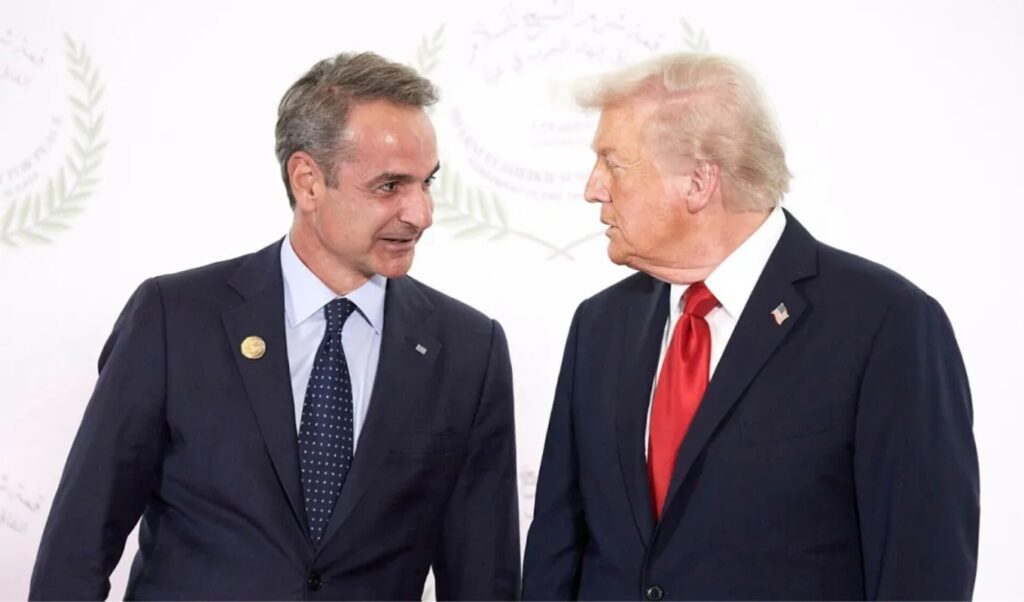
The issue is expected to occupy today’s European Council session, where Greek Prime Minister Kyriakos Mitsotakis will attend and where a unified stance among European Union member states toward Donald Trump’s initiative is expected to be recorded.
Complex, however, appears to be Greece’s position on the issue, following Turkey’s and Israel’s positive response to participate in Trump’s Peace Council. This fact could affect balances in the Mediterranean, given the role of the American factor in the region, especially at a time when the second part of Trump’s plan for peace in the Gaza Strip is being implemented, in which our country has declared its active participation.
Mr. Gerapetritis clarified in yesterday’s interview that the original idea of establishing the Peace Council had been made as part of the peace plan for Gaza. As he explained, “what I must emphasize is the fact that there is a specific UN Security Council resolution. It is resolution 2803, which Greece as an elected member voted for. This stated that the Peace Council would refer to Gaza and that it would be a temporary mechanism for resolving the Middle East issue and specifically in the Gaza area. The proposal that came to us – and it’s significant that it was addressed to Greece, because it didn’t go to all Europeans, it went to a relatively small number of Europeans – is a proposal that doesn’t only concern Gaza, but generally concerns disputes that appear, and also has permanent characteristics. So there is a relative distance between the resolution and the Peace Council.”
Based on this reasoning, our country is expected to support its arguments for rejecting, as anticipated, Trump’s Peace Council plan.