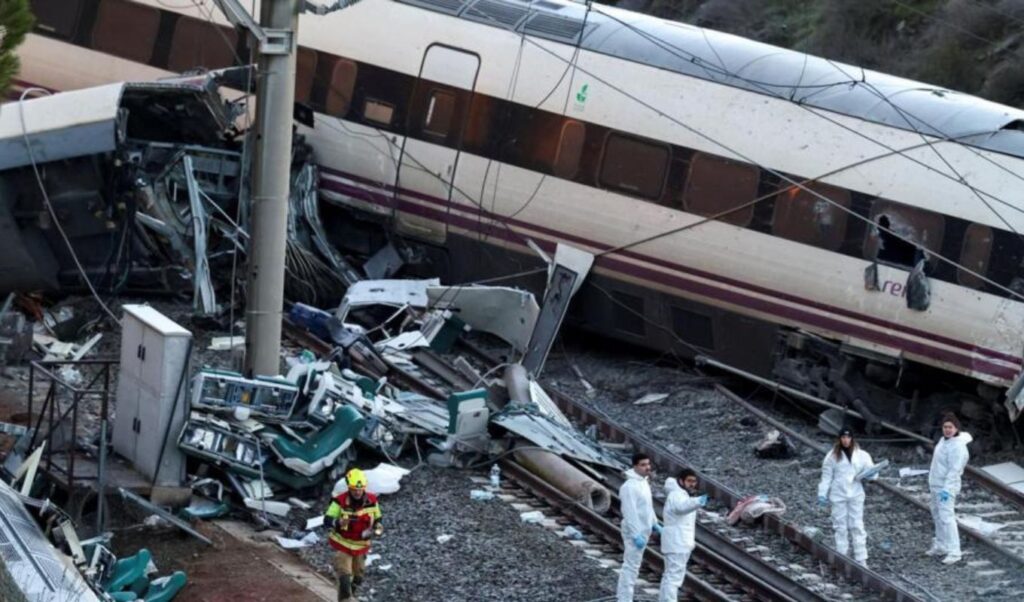
Spain remains shocked after the fatal collision of two trains near Adamuz in Córdoba province, where according to a new toll 41 people lost their lives, while more than 120 have been injured, including children. Heavy machinery has been deployed to assist in recovery efforts following the train derailment that led to the collision of two high-speed trains in southern Spain. Authorities and rescue teams worked for a second night at the accident site, as there are fears that more bodies remain trapped in the wreckage.
At least three bodies remain trapped in the debris, Spanish Interior Minister Fernando Grande-Marlaska said at a press conference. He stated that police had received 43 reports of missing persons, which largely corresponded to the provisional death toll, but warned that the final number would not be confirmed until rescue teams lift the most damaged carriages to see what lies beneath.
Spain train tragedy: Over 120 injured
More than 120 people were injured when the rear carriages of a Madrid-bound train derailed and crossed into the opposite track, colliding with an oncoming train at Adamuz.
Authorities have repeatedly warned that the death toll may rise as rescuers continue searching for bodies among what Andalusia regional president Juanma Moreno described as “a shapeless mass of metal.”
According to Spanish media, a defective or damaged rail weld is being investigated as a factor in the collision.
Investigators have identified a broken connector in the rails. According to a Reuters report, this is a critical point that may have caused the disaster. A photograph from the authorities’ investigation has been released showing the broken section in the railway lines.
Experts say the faulty railway connection could be the “key” to determining the cause of the derailment that led to the collision between the two trains.
Reuters reports that a source briefed on the investigation said technicians analyzing the rails on-site found some wear on the connector between rail sections, which “had been there for some time.” They say this created a gap between the rail sections that widened as trains continued to travel over the tracks.
Experts focus on rail weld
According to Spanish media, experts are focusing on a rail weld at kilometer 318.7 of the line, which reportedly broke at the exact moment of the accident at 7:45 PM local time. There are reports of a gap of about 30 centimeters, likely the result of material fatigue or poor welding.
Yannos Grammatidis, former president of OSE, speaking on the Live News program, commented that indeed there appears to be a missing piece from the train rails.
“I don’t know if it was found, the investigation will discover that. We cannot speak of material failure on the part of the train. It was a modern train. The accident most likely occurred due to a fault at this connection point. There are recording cars that monitor the rails. There were complaints from train drivers about problems with the rails,” he said.
Police report that the three rear carriages of a train carrying about 300 passengers derailed and crossed into the opposite track. They collided with the front of an oncoming train carrying nearly 200 passengers, causing both trains to overturn.
Since August 8, 2025, the Spanish Train Drivers’ Union had informed and warned the Ministry of Transport in a letter about “serious wear” and vibrations in the high-speed network, requesting speed limit reductions.
“We will learn the truth, we will find answers, and when we know the cause of this tragedy we will make it public with absolute transparency and clarity,” said Spanish Prime Minister Pedro Sánchez.
Spanish Transport Minister Óscar Puente said investigators are trying to determine whether the fracture of a section of railway track was “the cause or the consequence” of the derailment, according to a New York Times report. He warned that, for now, any theories are merely speculation as investigators continue to work.
The president of Spain’s Railway Accident Investigation Commission, Íñigo Barrón, told Spanish broadcaster RTVE that so far, the accident does not appear to have been caused by human error or signaling problems.
“What always plays a role in a derailment is the interaction between the track and the vehicle, and that’s what the commission is currently examining,” he said.