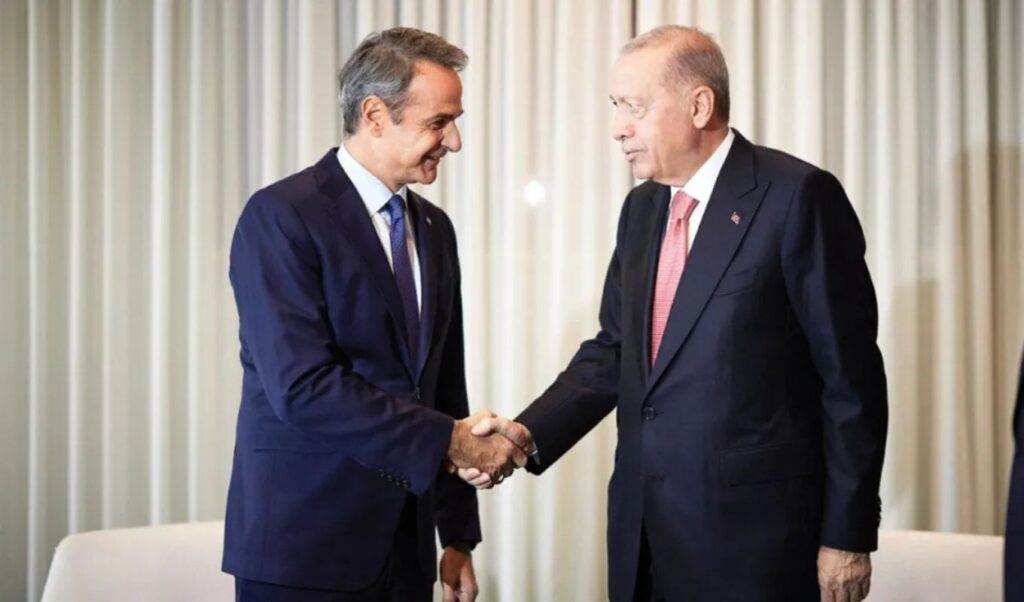
Greece-Turkey relations are expected to enter a new trajectory following Turkey’s apparent intention to “sit at the table” with Greece until a solution to the Aegean problem is found, as Turkish Foreign Minister Hakan Fidan characteristically stated yesterday. The beginning of the thread lies in the meeting that, as everything indicates – and barring unforeseen circumstances – Greek Prime Minister Kyriakos Mitsotakis and Turkish President Recep Tayyip Erdogan will have in the immediate future, most likely in the first half of February.
Professor Emeritus of International Law and former Deputy Foreign Minister Christos Rozakis, who played a crucial role in negotiations with Turkey under the Simitis government, argues to parapolitika.gr that any search for a solution to the two pending issues – the determination of EEZ and continental shelf – should be resolved within the framework of international law at the International Court of Justice in The Hague with Turkey’s agreement.
Rozakis to parapolitika.gr: “No one ever wins everything they believe at The Hague, but it can end a long-standing dispute”
As he characteristically says, “the difficulty is dialogue of course, in the sense that dialogue has failed for so many years, with the exploratory contacts etc. I don’t really believe in dialogue. On the contrary, the International Court of Justice in The Hague has the potential to solve the problems. The issue is to convince the Turks through the initial dialogue they will have to accept the referral of only the continental shelf and Exclusive Economic Zone to the Court and forget the rest, or leave the rest for the future.”
However, the counterargument that has existed for years, from many sides within Greece, regarding referral to The Hague, is the mandatory acceptance of the Court’s result, because as Mr. Rozakis argues “you don’t win everything.” When asked whether we should accept whatever decision, he tells us: “We should accept it. Of course. Look, the point is that no one at The Hague ever wins everything they believe. There will inevitably be certain deviations from our initial claims. But beyond that, The Hague can end a long-standing dispute of ours. Which is the decisive dispute for Greek-Turkish relations and the real dispute for Greek-Turkish relations. So from then on we will inevitably have the possibility of more respite in our problems and possibly even friendship with Turkey, which I believe is possible, or at least peaceful relations between the two countries, without these burdens we have today, and this is something feasible to happen.”
The role of the new policy being implemented by the US perhaps plays an important role in the need for the two countries to try to seek solutions. “Perhaps the fear that the United States might influence us in the Greek-Turkish dialogue could accelerate things. In the sense that Greece of course does not want the United States to intervene in the Greek-Turkish dispute. This is something that may have played a role, of course.”
Avramopoulos on Mitsotakis – Erdogan meeting to parapolitika.gr: “Dialogue is necessary, but cannot substitute clarity – Peace is not built with gray zones”
Former Foreign Minister and Commissioner of our country, Dimitris Avramopoulos, in a statement to parapolitika.gr, highlights the critical juncture at which the meeting of the two leaders is expected to take place and supports the need to apply international law for resolving our national issues. As he states: “The meeting of Prime Minister Kyriakos Mitsotakis with Turkish President Recep Tayyip Erdogan takes place during a period of increased geopolitical fluidity, where every public statement acquires particular weight. The recent statements by Turkey’s Foreign Minister about the Aegean are not mere rhetorical references. They constitute indications of the issues that will be raised and, if not clarified, may touch the core of our national sovereignty, bringing back a logic of contestation that is incompatible with international law. Perhaps the most important meeting in recent years. Greece approaches the dialogue with consistency and clear adherence to international law. Dialogue is necessary, but cannot substitute clarity. Peace is not built with ‘gray zones,’ but with clear rules, mutual trust and respect. The Aegean does not constitute a field for negotiating national sovereignty, but a space of peace, cooperation and stability.”