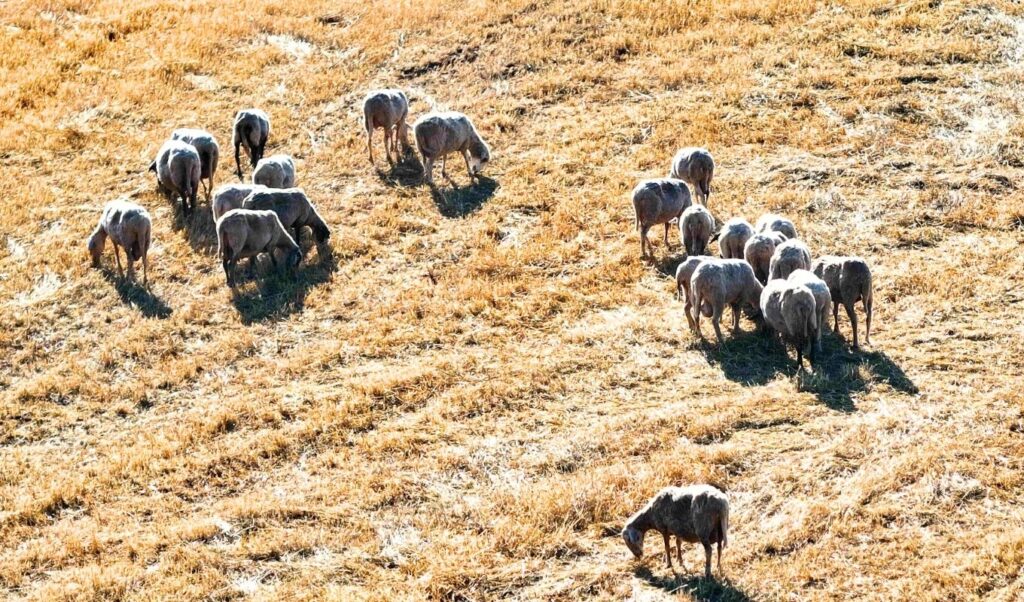
Following reports and claims that question the management strategy for sheep and goat pox, the National Scientific Committee for the Management and Control of Pox (NSCMCP) issued a series of clarifications, responding to seven key points raised in public discourse.
Sheep and goat pox: 7 responses to inaccurate vaccination claims
In its detailed memorandum, the National Scientific Committee for the Management and Control of Pox (NSCMCP) states that vaccination is not an automatic solution and does not eliminate the need for strict implementation of biosafety measures for sheep and goats, nor does it mean the end of the epidemic or lifting of restrictions. It emphasizes that decisions for managing the epizootic are based on the European regulatory framework and the country’s epidemiological situation.
1. Claim: “There is an ‘easy solution’ with mass vaccination – and the Ministry rejected it”
This claim does not correspond to the current European regulatory framework. Sheep and goat pox is classified as a Category A disease under Regulation (EU) 2016/429 and is not treated as an endemic disease, making its eradication a strategic goal. Category A diseases are characterized by the fact that they do not normally exist in the European Union and require immediate mobilization for complete elimination once detected. This categorization entails mandatory culling of entire herds upon confirmation of cases (stamping out), protection and surveillance zones typically 3km and 10km around the outbreak with complete prohibition of animal movements, and finally, prohibition of vaccination: preventive vaccination is prohibited so that animals remain “diagnostically distinct” from infected ones and the status of “disease-free area” is maintained. Additionally, this vaccination prohibition policy for these specific diseases protects the European Union itself and its member economies from massive imports of products from large states that do not meet these specific standards.
In other words, the European Union applies a “zero tolerance” policy for sheep and goat pox. This applies because the disease’s appearance leads to immediate border closure for exports of live animals, meat and dairy products from affected areas to third countries, meaning enormous economic losses. Also, the virus is characterized by high transmissibility and environmental resistance and can be easily transmitted through equipment, vehicles, feed and materials from infected farms, while the cost of eradication is very high as farmer compensations, laboratory testing costs and farm disinfection expenses constitute an enormous burden on the state budget. Finally, what we are trying to avoid is losing “Disease-Free Country” status: A country that loses disease-free status faces multi-year restrictions on international trade, something that severely impacts livestock production.
Furthermore, based on what is mentioned in paragraph 8.6.3 of the EFSA-European Food Safety Authority bulletin (EFSA Journal 2014;12(11):3885) and in paragraph 2.4 of the more recent EFSA bulletin EFSA Journal 2021;19(12):6933, “none of the existing live vaccines against pox are licensed for use within the EU and the use of these vaccines would impose immediate restrictions on international trade of live sheep and goats and their products”. Member states can, by their own decision and given that they must bear these restrictions on international trade, implement preventive vaccination for Category A diseases to prevent spread and the need for drastic control measures. However, because vaccination can “hide” the underlying pox virus infection, meaning we do not achieve disease eradication, strict risk mitigation measures are imposed on movements, and an exit strategy with enhanced surveillance for recovering the area’s health status. The specific conditions (vaccine type, zones, restrictions) are determined based on scientific experience and data (EFSA, WOAH).
Vaccination is not a universal, automated or “easy” solution mainly because it entails long-term restrictions on international trade, but constitutes a limited ring vaccination tool that can be used exclusively under strict conditions, based on an official and approved plan, with enhanced surveillance, maintenance of complete records of vaccinated animals and strict rules for animal and product movement until completion of the prescribed recovery periods. In any case, vaccination does not eliminate the need for continuous surveillance, controls, traceability and strict implementation of biosafety measures, nor does it automatically mean the end of the epidemic or immediate lifting of restrictions. The cornerstone of management remains consistent implementation of the control and eradication plan, in close cooperation with competent veterinary authorities and Regional governments.
2. Claim: “The Ministry ‘fears’ vaccination without reason – it is safe/effective”
The Ministry does not “fear” anything; it implements scientifically documented decisions. The National Scientific Committee for the Management and Control of Pox (NSCMCP), established on October 27, 2025, evaluated all available data and concluded that mass vaccination today would worsen the situation. Considering that vaccines contain live pox virus of reduced pathogenic power and because the disease has strong pathogenic potential, the use of vaccines, when done with limited adherence to biosafety measures in farms, carries the risk of spreading the disease instead of containing it. The current situation has proven the inability to maintain adequate biosafety measures, making vaccination scenarios in zones a dangerous practice for the country’s livestock. The Ministry wants to avoid vaccination to protect the country’s livestock sector, something that will only be achieved through understanding the factors leading to this decision and cooperation from farmers and all involved in disease management throughout the territory.
Additionally, international experience is clear: no country that implemented vaccination definitively eradicated the disease; pox became endemic, culling continued and productive yields decreased. The available emergency vaccines on European territory have only been tested on a limited number of animals, making universal use risky. The Ministry exhausts every effort to eradicate the disease without using vaccines so that our country does not lose its Disease-Free Country status and does not face multi-year restrictions on international trade, especially given the enormous importance of feta and other goat and sheep dairy product trade in the European Union and third countries (USA, Canada, Australia and United Kingdom). The only strategy that guarantees protection of farmers and production is strict implementation of biosafety measures and the control/eradication plan. Any claim about “easy” or “safe” mass vaccination ignores reality and misinforms producers and consumers.
Some vaccines may present unacceptably high levels of residual pathogenicity, while there is a lack of evidence from studies demonstrating the safety of SPP/GTP vaccines in European animal breeds.
3. Claim: “There are vaccines – so you could have brought them/made them”
The Ministry has categorically clarified that there is no licensed (approved) vaccine against sheep and goat pox either in Greece or the European Union. This position has also been documented with a letter from the National Organization for Medicines.
Therefore, the import, distribution or use of unapproved preparations is illegal.
According to the EFSA Journal 2021; 19(12):6933 doi: 10.2903/j.efsa.2021.6933 publication, none of the existing live vaccines for sheep pox (SPPV) and goat pox (GTPV) are licensed for use within the EU and the use of vaccines would impose immediate restrictions on international trade of live sheep and goats, as well as their products.
The National Scientific Committee for the Management and Control of Pox and the Ministry are obligated to operate institutionally and follow legislation, regulations, and other executive decisions from institutional bodies and not individual recommendations and personal opinions of individuals not confirmed by institutional bodies.
4. Claim: “Whoever vaccinates on their own helps – and the Ministry ‘demonizes’ it”
The illegal or “improvised” use of unapproved vaccines not only lacks scientific data support, but also sabotages every state effort to control the disease, directly undermines the public interest and is ultimately deemed catastrophic for the country’s livestock sector. It creates serious confusion in surveillance, alters the epidemiological picture and this practice combined with non-implementation of biosafety measures have proven responsible for the virus’s uncontrolled spread in our country.
The unapproved vaccines circulating today do not allow serological distinction between infected and vaccinated animals (DIVA principle). As a result, serological laboratory surveillance becomes practically impossible, with immediate and serious consequences both for disease management and international trade of live animals and livestock products. Simultaneously, there is a risk of vaccine strain transmission to unvaccinated animals, while the theoretical risk of recombination with circulating natural virus strains cannot be excluded, with unpredictable implications for public and animal health.
According to the current European regulatory framework, in case of virus detection in a herd – regardless of whether animals have been illegally vaccinated or not – mandatory culling of the entire animal stock is applied. Therefore, illegal vaccine use not only does not protect producers, but exposes them to greater losses, strict movement restrictions and creation of different health statuses within the country (free and vaccinated areas).
The use of unapproved immunological products is dangerous, illegal and incurs penalties. The Ministry does not “demonize” any practice; it protects public health, farmers and the country’s international credibility.
5. Claim: “You didn’t take measures / the measures failed”
The measures provided by the European regulatory framework for sheep and goat pox have been taken and are being implemented according to Regulations (EU) 2016/429 and 2020/687. These measures include immediate culling of animals in outbreaks, meticulous cleaning and disinfection of facilities, establishment of protection and surveillance zones with predetermined durations, strict traceability and control of animal and product movements, as well as enhanced surveillance.
The evolution of the epidemiological picture does not prove measure failure, but highlights the consequences of non-universal compliance, violations (illegal movements, undeclared farms, violation of biosafety rules) and delayed case reporting, which undermine the functioning of any control system.
According to the current regulatory framework, eradication measures do not operate fragmentarily or “automatically.” Lifting restrictions and recovering free status requires complete and consistent implementation of all measures throughout the production chain. Where this is not maintained, the epidemic is prolonged.
Therefore, the issue is not the absence of measures, but the need for stricter implementation, intensification of controls and strengthening compliance of all involved, so that measures can produce the expected result.
The Ministry implements and continuously updates biosafety and control measures, in cooperation with Regional governments and competent services under NSCMCP guidance: zones, movement restrictions, controls, disinfections, traceability and surveillance enhancement in the field. Measure effectiveness requires universal compliance throughout the chain. In an epizootic, violations primarily harm farmers who follow the rules.
6. Claim: “You don’t vaccinate so PDO products/feta aren’t affected – so it’s a political/communication choice”
The Ministry makes decisions with the goal of protecting public health, animal stock and Greek livestock credibility, not in communication terms. Every strategy has immediate consequences for animal health status and trade of animal products, as defined by the European framework. The country must weigh impacts on exports and ensure complete maintenance of “disease-free” status, safeguarding Greek production viability and product credibility.
Consistent stamping out implementation leads to rapid epidemic curve decline, shorter restrictions and faster return to normalcy. This is not an anti-vaccination stance, but a strategy consistent with virus biology, European law and Greek livestock viability, ensuring protection of farmers and exportable products, such as feta.
7. Claim: “You didn’t provide compensations / you’re deceiving farmers”
The Ministry has activated and fully implements the support and compensation framework. Specifically:
(a) Compensations for animals killed due to pox
Compensations for killed animals in the context of sheep and goat pox have already exceeded 62 million euros to date.
Compensation is determined up to 250 euros per animal, according to provisions, documentation evidence and related controls.
It is clarified that amounts are paid by the Ministry to Regional governments, which then proceed with payments to farmers, based on statements and the procedure maintained.
(b) Additional support for lost income
Simultaneously, additional support for lost income has been implemented, totaling 29 million euros, which has been paid, with support per animal according to the measure’s scaling (70€ or 35€ per animal, depending on category/eligibility criteria).
(c) Also, 7 million euros have been given for operational expenses to Regional governments
(d) Finally, 70 million euros have been given for animal feed
The NSCMCP’s final note
The National Scientific Committee for the Management and Control of Pox and the Ministry, as stated in the relevant memorandum, must point out in the most categorical way that the spread of unfounded claims and reproduction of news lacking scientific documentation constitute the greatest threat to efforts to contain sheep and goat pox.
“The refusal to accept documented guidelines and demonization of health measures have proven completely catastrophic, leading to inability to control the disease and exposing our country internationally.
At this critical juncture, farmers and all involved parties are called to consider the magnitude of their responsibility, set aside misinformation and fake news and cooperate with absolute honesty with the Ministry. Only through joint action and respect for scientific data can we ensure disease elimination and survival of our country’s livestock sector” the NSCMCP’s related press release also emphasizes.