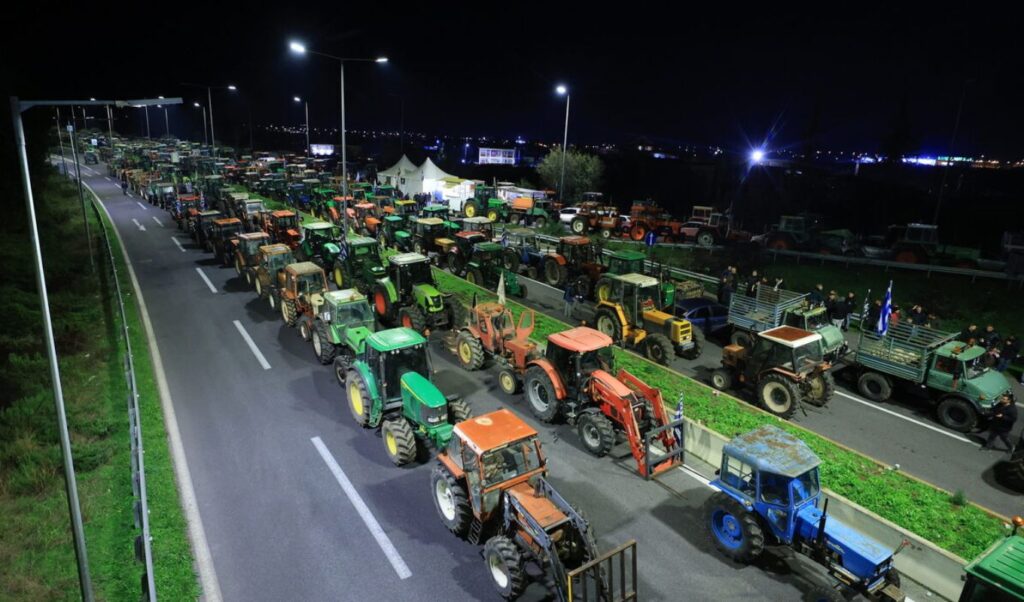
Farmers remain at blockades in many regions across the country, sending a clear message that they do not intend to back down unless there is substantial response to their demands. Despite the festive atmosphere of the season, the mobilizations continue with adjustments to limit inconvenience to citizens, without abandoning their struggle, as they emphasize.
Farmer blockades: Where problems are observed by region
In Central Greece, tractors remain at national highway blockade points, with farmers having decided to continue their actions even during Christmas. At Bralos, although agricultural machinery is positioned on the national highway, it was decided for Monday to keep auxiliary roads and the provincial network open to avoid serious traffic problems. The president of the Agricultural Association of Lamia, Giorgos Paliouras, explained this stance, characteristically noting that “this specific stance constitutes a conscious choice. We want to facilitate people passing through our area without creating additional problems for them during these days”. At the same time, he made it clear that after the holidays, mobilizations are expected to escalate. Farmers in Evia began a new cycle of mobilizations by blocking the High Bridge in Chalkida from 6 PM on Monday, December 22.
- Steady blockades in Kastro and Thebes – Adjustments ahead of holidays
At the blockades of Kastro and Thebes, tractors remain lined up, with local assemblies being called to decide the next steps of the struggle. For tomorrow, Tuesday, and also for Wednesday, it has been decided to keep one traffic lane open in each direction to facilitate movement ahead of the holidays. Despite individual accommodations, the message from all blockades in Central Greece remains non-negotiable. In Atalanti, Kastro, Thebes and Chalkida, farmers declare they will remain at mobilization points throughout Christmas, continuing a struggle that –as they emphasize– they cannot abandon.
- Mobilizations continue in Epirus – Symbolic actions and blockades
The situation is similar in Epirus, where farmers, livestock breeders and beekeepers continue their mobilizations at blockades in Arta, Louros Preveza, Kalpaki Ioannina and Igoumenitsa. In Arta, tractors remain positioned at the Ionian Highway bridge in both traffic streams, while in Louros the situation is similar, at the town’s exit toward Preveza. Particular symbolism was shown by the Agricultural-Livestock Association “THYAMIS,” which together with farmers, livestock breeders and beekeepers from the Igoumenitsa port blockade, distributed tangerines at the Tyria toll stations. As they emphasized, “it was not just a treat, but a thank you for the understanding, patience and support of citizens in their struggle.” For Monday evening, a two-hour blockade of Igoumenitsa’s outer port for trucks was scheduled, while in Kalpaki farmers will proceed with a three-hour blockade of truck traffic to and from the Greek-Albanian border at Kakavia. Meanwhile, Christmas trees are also present at the region’s blockades, as an indication that the struggle continues even during the holiday season.
- Western Thessaly: “We’re not leaving here”
In western Thessaly, farmers at the E65 blockades declare they are determined to stay. “We’re not leaving here. We continue the struggle,” is the message they send, while new tractors reinforce the blockades daily. Meanwhile, regular assemblies of an informational nature are held within the framework of nationwide coordination. Farmers in Karditsa decided that from Tuesday onwards, one traffic lane per direction will be maintained on the E65 to facilitate citizens’ movement ahead of Christmas.
- Western Greece on alert – Assemblies and blockades
Farmers and livestock breeders in Western Greece also remain on standby, with blockades in Aetolia-Acarnania, Achaia and Elis. At the Angelokastro blockade on the Ionian Highway, where mobilizations have lasted 17 days, a general assembly has been scheduled to determine next moves. In previous days, farmers also proceeded with a symbolic blockade of the Kouvara junction in Agrinio, while awareness actions continue. In Achaia, at the Eglykada blockade on Patras’ ring road, as well as in Kalavryta and Aigialeia, farmers remain in battle positions, without –in some cases– completely interrupting traffic. Finally, in Elis, blockades remain at the Pyrgos junction, on the old national highway Patras-Pyrgos at Lechaina, as well as on the national highway Patras-Tripoli at the height of Amaliada, with farmers declaring their struggle will continue until full vindication of their demands.
Police: Traffic diversion measures mandatory during farmer mobilizations
Sources from the Hellenic Police state that traffic diversion at farmer blockades is mandatory for safety reasons. Specifically, the sources emphasize: The Hellenic Police, within the framework of its institutional mission to ensure road safety and protect human life, takes necessary measures for traffic regulation and diversion in cases of road blockades and for as long as emergency obstacles or citizens remain on the roadway.
Particularly during farmer mobilizations, taking these measures is service-mandated and stems from the applicable legal framework, as the presence of agricultural tractors, fixed or mobile obstacles and pedestrians on the roadway creates objectively dangerous traffic conditions, regardless of anyone’s intentions or statements. Vehicle passage under these conditions carries increased risk of causing serious traffic accidents and, for this reason, traffic diversion constitutes the only option for preventing dangers and not a choice.
It is emphasized that these measures are taken not only to protect drivers and passengers, but also to protect the protesting farmers themselves, who move on foot on roads designed for rapid vehicle circulation and not for human presence. The Hellenic Police operates and makes related decisions based on documented risk assessment and not statements of good intention. In this context, it acts with the safety of all in mind and cannot permit vehicle circulation at points where human life is endangered. Compliance with traffic regulation measures constitutes a necessary prerequisite for accident prevention and ensuring public safety.