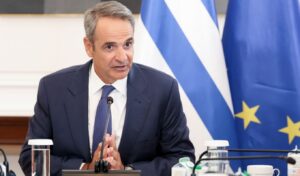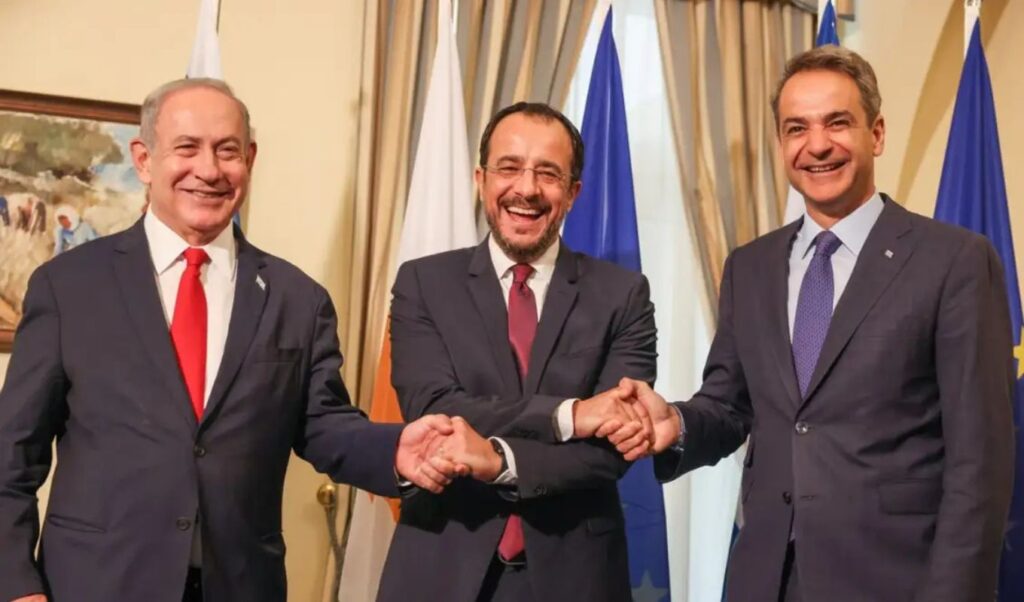
Following the trilateral summit between Greece – Cyprus – Israel at Foreign Minister level in Athens last spring, and the revival of the 3+1 format (with the US) at Energy Minister level in early November, today marks the first trilateral summit in two years: Kyriakos Mitsotakis is traveling to Jerusalem, where he will meet with his counterpart Benjamin Netanyahu (at 2:30 PM) followed by a Trilateral Summit (at 5:45 PM), the first since September 2023 in Nicosia. There, cooperation between the three states is expected to be confirmed and strengthened in the areas of defense, security, energy, innovation, connectivity and civil protection.
Earlier (at 12:30 PM), the prime minister will travel to the West Bank, specifically to Ramallah – the de facto administrative center of Palestine – where he will meet with Palestinian President Mahmoud Abbas (with whom he will have a working lunch), demonstrating in practice Greece’s commitment to continue being a stable and sincere interlocutor for both Israelis and Palestinians.
Greece’s message for Gaza ceasefire and critical momentum ahead of Cyprus-Israel trilateral
Greece emphasizes at every opportunity the need to maintain the Gaza ceasefire and provide massive humanitarian aid to Palestinian civilians. As Foreign Minister George Gerapetritis noted, “it is our strategic choice to have an active role in Gaza peace efforts, in the humanitarian sector and regional reconstruction,” while emphasizing that the government supports “Palestinian Authority reform, which we consider a necessary prerequisite for launching the political process aimed at implementing the two-state solution.”
The visit comes at a critical juncture for the region, with a fragile peace agreement signed following an initiative by US President Donald Trump. It also comes at a time when Israel, after the apparent end of the two-year war, appears to show renewed interest in Eastern Mediterranean cooperation frameworks, in which Greece plays a pivotal role, as well as in deepening its relationship with our country.
The Greece-Israel-Cyprus cooperation does not constitute a threat to Turkey, declared Turkish Defense Minister Yasar Guler, arguing that Ankara also signs defense agreements without targeting third parties. At the same time, he mentioned that Turkey takes necessary actions in case an air defense system is installed by Israel on Aegean islands.
It’s also worth noting that the Greek government is particularly interested in implementing the Greece-Cyprus-Israel electrical interconnection project, which represents one of the world’s largest underwater electricity transmission projects and has encountered several obstacles in recent months. “The government’s position is one – I want to make this clear – clearly in favor of electrical interconnection between Greece and Cyprus. It’s one of the three main pillars of our energy strategy,” declared Nikos Christodoulides, after a new dispute erupted within the Cypriot government over the cable.
The Greek government is also interested in implementing IMEC and including our country in this ambitious plan. Piraeus, Elefsina, and Thriasio can constitute a small but crucial and particularly important part of this broader and complex geopolitical puzzle. This puzzle is called the “India-Middle East-Europe Economic Corridor” (IMEC) and represents a major plan for a massive trade and economic route, in which Greece desperately wants to integrate and become a critical link in this chain.
Part of this planning is the northern maritime section connecting Haifa port in Israel with major European ports, one of which is Piraeus. Here the entire plan had essentially frozen over the past two years due to the Gaza war, however the peace agreement revitalizes Israel’s interest in IMEC as well.
“Greece is a country that traditionally maintains a strategic relationship with Israel but also excellent relations with the Palestinian Authority, so we will have the opportunity to discuss how we move from the phase of the first, much-desired ceasefire to the next stages of the plan, as at least agreed by all involved parties, and explore the role Greece can play in this direction,” Kyriakos Mitsotakis stated to journalists in Brussels, immediately after the European Union Summit concluded. “In any case,” the prime minister continued, “I want to reiterate that the Greece-Cyprus-Israel trilateral format brings together countries that constitute, I would say, factors and pillars of stability in the broader Eastern Mediterranean region, and I believe the discussions that will take place at this juncture, considering what has transpired in Gaza in recent years, will be extremely important.”