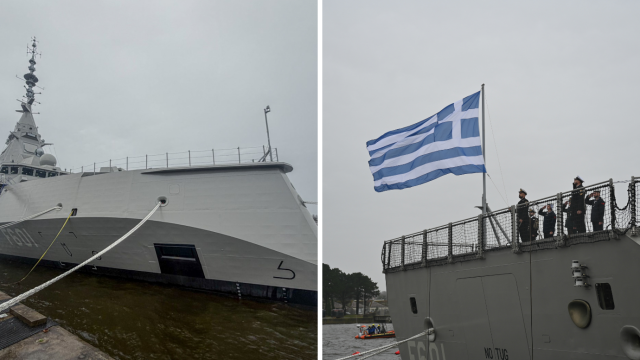
The arrival of the ultra-modern Belharra frigates (FDI HN), such as the “Kimon” (F-601), is reshaping the balance of power in the Aegean and Eastern Mediterranean, dramatically enhancing the strength of the Hellenic Navy.
In a period of increasing geopolitical uncertainty and revisionism, the FDI frigates mark a major technological leap for the Armed Forces, as they incorporate advanced area air defense systems, electronic warfare capabilities, and full network-centric interoperability. The acquisition of a new major surface unit – for the first time in almost 26 years – seals the operational upgrade of the Fleet.
“Kimon” as the Fleet’s first next-generation frigate – Four frigates by 2029
The “Kimon” is the first of four Belharra frigates to be integrated into the Greek fleet and represents a new generation ship, radically changing how Greece controls, monitors, and defends its maritime areas of interest. By 2026, the “Nearchos” and “Formion” are expected to follow, meaning that in about a year from now the Hellenic Navy will have three ultra-modern ships of this type. The fourth frigate, “Themistocles,” is scheduled for delivery in late 2028 or early 2029, completing the new high-tech naval quartet.
The Sea Fire radar and Aster 30 missiles
The key advantage of the FDI frigates is their area air defense capability – a feature being introduced for the first time on a Greek frigate. Until now, Fleet units provided local protection, mainly to themselves and neighboring ships. The “Kimon,” thanks to the advanced Sea Fire radar and Aster 30 missiles, can cover wide maritime and aerial space, creating a “umbrella” of protection over ship groups, islands, or critical maritime zones. The Hellenic Navy stops simply reacting to threats and gains the ability to shape the operational field.
Additionally, the Sea Fire doesn’t operate in isolation but integrates into a broader network of sensors and platforms, utilizing data from UAVs, aircraft, other surface units, and ground surveillance structures. Thus, the “Kimon” is not limited to what it detects on its horizon but “sees” what the entire network reveals. This gives the Hellenic Navy reaction time, the most critical factor in an environment like the Aegean, where distances are small and developments extremely rapid.
How “Kimon” creates protection “umbrella” at sea and air
The geographically dense and operationally demanding environment of the Aegean, with dozens of islands and limited maneuvering margins, makes saturation attacks a serious threat. The “Kimon” has been designed to respond to multiple simultaneous threats – from air, surface, and underwater. The combination of advanced sensors, automated combat systems, and modern weapons allows the frigate to prioritize targets and react instantly, essentially changing the balance in a potential high-intensity incident. The “Kimon” also decisively enhances underwater control. The CAPTAS-4 towed sonar gives it the ability to detect submarines at long distances, significantly improving the Fleet’s anti-submarine picture. This capability functions as a deterrent, forcing opponents to operate with more restrictions and increased risk.
The new naval doctrine: fewer but more powerful units
Beyond advanced operational capabilities, the new frigate incorporates a different doctrine: fewer but more capable units, high connectivity, emphasis on information and cooperation. This is a philosophy that responds to modern naval warfare requirements and the geographical specificity of the region. For the Hellenic Navy, it’s not simply a Fleet enhancement, but a “tool” for transitioning from attrition management to the era of active deterrence.
Fleet modernization doesn’t end with the Belharras. In the coming years, the upgrade of MEKO frigates (“Hydra” class) is expected to be completed, while Athens is in discussions for purchasing two or four Italian Navy FREMM-type frigates (Bergamini class). In parallel, the mid-life upgrade of Type 214 submarines takes priority, although discussions have already opened for acquiring new ones, with a 2035 horizon.
Published in Apogevmatini