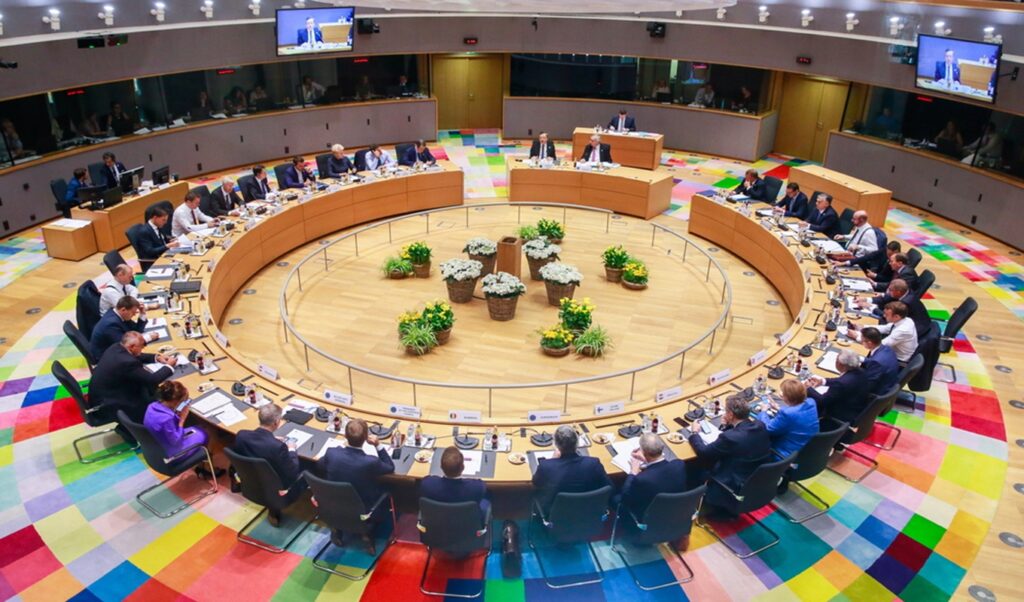
After marathon negotiations in Brussels, European Union leaders reached an agreement at the Summit to fund Ukraine with approximately 90 billion euros for the period 2026-2027.
EU: Agreement for 90 billion euro loan to Ukraine for 2026-2027
As announced by European Council President António Costa via X: “The decision to provide 90 billion euros to support Ukraine for 2026-2027 has been approved. We committed, we delivered“.
We have a deal.
Decision to provide 90 billion euros of support to Ukraine for 2026-27 approved.
We committed, we delivered.
— António Costa (@eucopresident) December 19, 2025
The leaders failed to reach an agreement on the use of frozen Russian assets as loans to Ukraine, however they reached unanimous agreement for a 90 billion euro loan to Ukraine.
Earlier, the 27 European Union leaders were trying to bridge their differences over a support package that would cover Kyiv’s needs for 2026-2027, at a time when Ukraine faces a serious fiscal deficit and continued military pressure from the Russian invasion. However, scenarios change hour by hour. Every time a proposal seems to be favored, objections arise from different sides. Thus, we have an ongoing leaders’ summit with continuous reversals. The only common denominator is everyone’s intention for a decision to be made and not to send a signal of failed cooperation.
Belgium, which hosts most of the frozen Russian assets through Euroclear, demanded full guarantees from the remaining member states for any legal or economic consequences from potential Russian retaliation.
Where the negotiations got stuck
Despite assurances from the European Commission and efforts for joint risk-sharing, the negotiations got stuck on one word regarding the amount of guarantees, with leaders temporarily breaking off without a final decision on this plan. In this context, a temporary “bridge loan” emerges as an alternative solution through joint EU borrowing from capital markets, “backed by the EU budget headroom“, meaning through a funding mechanism that the European Union uses to borrow money from capital markets with favorable terms, without directly burdening the national budgets of member states.
Technically, the EU budget has a ceiling (own resources ceiling), which is the maximum amount the EU can request from member states as contributions (based mainly on each country’s Gross National Income). From this ceiling, a portion is used for actual budget expenditures (e.g., subsidies, programs). The remainder, the difference between the ceiling and actual expenditures, is called headroom (reserve or margin).
This headroom functions as a guarantee. It allows the EU to issue bonds (borrow) in the markets, with the guarantee that, in case it cannot repay (e.g., due to crisis), it will be covered by future member state contributions up to the ceiling. Thus, the EU gets low interest rates due to high credit rating, and the borrowed money can be given as loans to third parties, such as Ukraine.
The proposals
The latest draft Conclusions that leaked recently proposes exactly this. A 90 billion euro loan for 2026-2027, with explicit assurance that it will not affect the financial obligations of countries like Czech Republic, Hungary and Slovakia – an obvious concession to appease the reservations of certain members, as approval requires unanimity.
Despite the fluid situation, political will for a solution remains strong. Many leaders, including Polish Prime Minister Donald Tusk, emphasized upon arrival at the Summit that Europe faces a choice. “Money today or blood tomorrow“.
European Commission President Ursula von der Leyen declared her determination not to leave Brussels without a solution, while European Council President António Costa promised that leaders would remain until an agreement is found.
Source: ANA-MPA