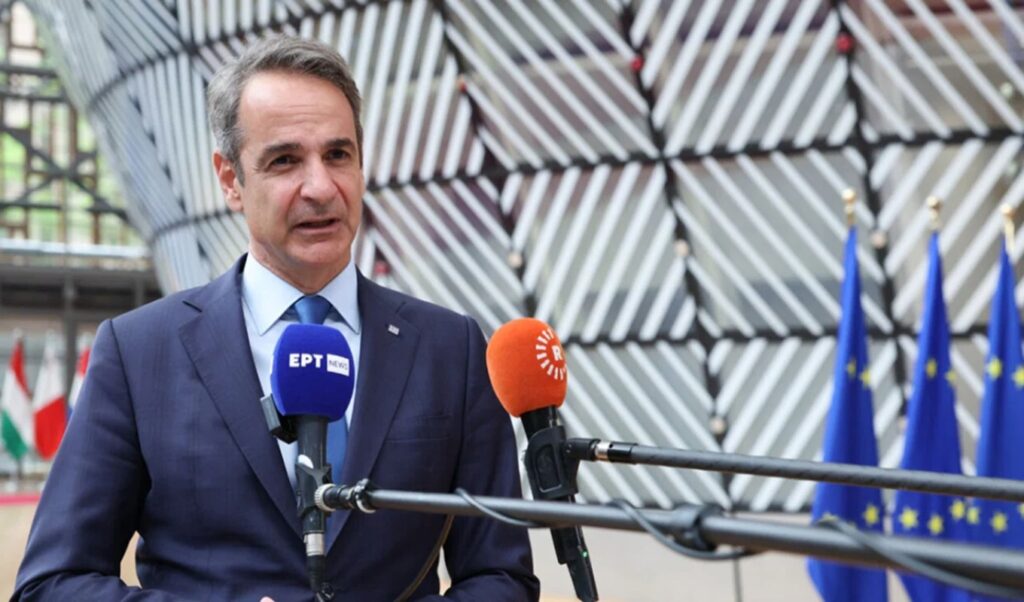
Prime Minister Kyriakos Mitsotakis held a press conference after the conclusion of the EU Summit in Brussels, discussing the agreement reached regarding the bridge loan to Ukraine.
Mr. Mitsotakis noted that “an extensive discussion took place where both financing options for Ukraine proposed by the European Commission were examined“. He added: “I believe that the solution that was chosen, namely a loan from the European budget margin that has no fiscal consequences for any European country, is the appropriate solution“.
Mitsotakis after EU summit: “Europe stands with Ukraine, ‘yes’ to dialogue with farmers”
The Greek Prime Minister said that “this decision was made taking into account the complexity and legal difficulties of the project to utilize the frozen Russian assets at this moment, a possibility which was not excluded in the conclusions we agreed upon, but which needs more time for elaboration in case we reach this solution“.
Mr. Mitsotakis emphasized that “in any case, the message sent from the European Council is that Ukraine can cover its financing needs for the immediate future and that Europe stands practically by its side“.
Mitsotakis on Multiannual Financial Framework: “Negotiations will be complex and difficult”
Regarding the multiannual financial framework and whether he sees a risk that resources for defense and Ukraine might “sacrifice” others, Mr. Mitsotakis said: “Discussions for the multiannual financial framework are just starting now. No specific proposal has been made beyond the Commission’s initial position regarding amounts and how they are distributed across various categories of the European budget. One thing is certain and this became apparent in today’s discussion: there is a critical mass of countries, which I would characterize as friends of cohesion and the common agricultural policy, that will essentially not accept cuts to these two programs, which constitute the two main pillars upon which the entire framework of European financing has been built in recent decades. However, I estimate that these negotiations will be complex and difficult“.
The Greek Prime Minister added that “the Cypriot Presidency, which takes over in 12 days, will present, I assume, its first proposals for specific resource allocations and we hope and wish that in a year from now we will be able to agree on the next multiannual financial framework“.
Mitsotakis: Greece as a “bridge” for peace in the Middle East
When asked about Greece’s role as a “bridge” in the Eastern Mediterranean and its potentially more active role in shaping European stance on the Middle East ahead of his Monday visit to Jerusalem and Ramallah, Mr. Mitsotakis said: “First of all, I consider it significant that I will visit on Monday, within the framework of the trilateral meeting of Greece – Cyprus – Israel, both Ramallah and obviously Jerusalem. Greece is a country that traditionally maintains strategic relations with Israel but also excellent relations with the Palestinian Authority, so we will have the opportunity to discuss how to move from the phase of the first much-desired ceasefire to the next stages of the plan as it has at least been agreed upon by all involved parties and to explore the role that Greece can play in this direction. In any case, I want to repeat that the trilateral scheme of Greece-Cyprus-Israel brings together countries that constitute, I would say, factors and pillars of stability in the broader Eastern Mediterranean region and I estimate that the discussions that will take place at this juncture, taking into account what has transpired in Gaza in recent years, will be extremely significant“.
Mitsotakis on farmers: “Yes to dialogue, no to disrupting society”
Regarding the farmers’ protests in Greece, Mr. Mitsotakis stated: “Some farmers feel the need to disagree with the proposals made by the government. The government remains open to dialogue. We say ‘yes’ to dialogue but we say ‘no’ –in every way and tone– to the unnecessary disruption of society and to the impacts that a potentially prolonged blockade would have on the economy’s functioning. Christmas is coming, I think everyone understands that people want to move around, some want to return to their villages, winter destinations want to operate. And I think this is something that everyone will take very seriously into account. Beyond that, the government has carefully examined farmers’ problems. It believes it has addressed many of the justified demands. But obviously we will not give in to any, I would say, maximalism that takes us out of the European framework which is very well defined and ultimately leads us to solutions that cannot be accepted either by the government or by Europe. Furthermore, I want to emphasize and repeat in every way that the restructuring, the integration of OPEKEPE into AADE, for which there will be a roll-call vote tomorrow, actually today, because it’s 4 AM Greek time, constitutes a test and challenge for all parties whether they really mean what they say about wanting a system of transparent subsidies and having subsidies go to those who truly deserve them. They must support this reform and not bury their heads in the sand. This reform has already led to resource savings. Resources that will be redistributed as we have said to our livestock farmers who have real needs, to producers, to cotton producers. And in this way we ultimately prove in practice what we say, that not only are European resources not lost, but ultimately the money that will be saved from system restructuring will benefit those who truly need it“.