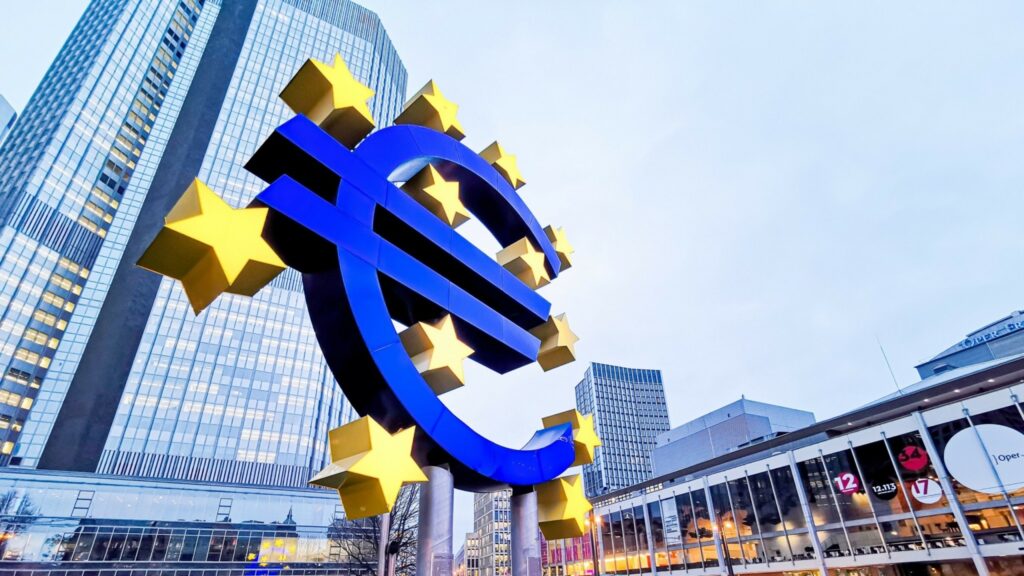
The European Central Bank (ECB) kept interest rates unchanged at 2% in yet another meeting, the fourth consecutive session without changes to monetary policy. Analysts agree that ECB interest rates have now stabilized at a “good level,” following one of the most aggressive easing cycles in recent years. Meanwhile, the ECB raised its growth forecasts for 2026 and 2027. In statements made by ECB President Christine Lagarde, she assessed that the European economy has shown resilience. “Services continue to dominate, particularly the IT sector, which is likely to continue,” she emphasized. “Investments by both governments and businesses support growth,” she underlined. However, the banker repeated her previous assessment that trade will continue to weigh on eurozone growth in 2026.
On the inflation front, Lagarde noted that it has remained within a narrow range since spring. As she added, underlying inflation indicators have also not changed significantly and remain aligned with the 2% target. Inflation is expected to decline in the near term due to energy sector effects, the ECB President estimated. The return to target in 2028 partly reflects the introduction of the new Emissions Trading System 2 ETS2, as previously anticipated, she emphasized.
Lagarde on inflation and tariffs
Christine Lagarde then proceeded to assess risks, saying that the unstable international environment could still cause disruptions. However, defense and infrastructure spending may boost growth more than expected, and increased confidence could fuel spending. It should be recalled that in the last meeting in late October, the Central Bank had assessed that developments had “mitigated some of the downside risks to economic growth,” but did not proceed to forecast that these risks are balanced.
According to Ms. Lagarde, inflation prospects are described as “more uncertain than usual” due to external factors. Tariffs and a stronger euro continue to be considered among the downside risks, while fragmented supply chains, slower deceleration of wage pressures, and extreme weather events could push inflation higher.
ECB: What to expect for interest rates until 2027
Despite international divergences –with the Federal Reserve in the US and Bank of England moving toward cuts– the prevailing view in Frankfurt is that there is no immediate need for further interventions. However, uncertainty has not completely disappeared, keeping interest focused on the ECB’s rhetoric and the guidance from chief Christine Lagarde.
The ECB’s deposit rate remained at 2%. This is the fourth consecutive meeting during which the central bank maintains unchanged borrowing costs, after eight 25 basis point cuts that brought rates from 4% to the current level. Most analysts estimate that ECB interest rates will remain stable until 2027, with the majority now considering the next move more likely to be an increase rather than a new cut.
This sentiment has been transferred to markets, particularly after the statement by Isabel Schnabel, ECB Executive Board member, that she feels comfortable with the possibility that the next rate move could be upward. However, the picture is not uniform internationally.
The Federal Reserve proceeded with a rate cut last week, while the Bank of England lowered rates to 3.75% (from 4%), with both leaving open the possibility of further easing in 2026. At the ECB, conversely, the appetite for rate changes is limited.
ECB officials appear increasingly confident that the economy of the 20 eurozone countries will maintain its resilience, while inflation will remain close to the 2% target in the medium term. Nevertheless, some uncertainties continue to exist. ECB President Christine Lagarde is expected to keep all options open in the press conference following the decision announcement at 14:45 Frankfurt time.
As Goldman Sachs’ chief economist for Europe, Jari Stehn, noted, “it will be interesting to see if Lagarde’s tone changes,” adding that the chances of a new cut in 2026 have declined further.
“Interest rates are in a good place“
Most policymakers repeat that the level of interest rates is now in a “good place,” sending a message of reluctance to continue easing.
Even Lithuania’s central bank governor Gediminas Šimkus, who until recently belonged to the minority that considered a new cut likely, stated that he no longer sees a need for further easing, not only in the December meeting but also in upcoming ones. Nevertheless, discussions about future flexibility have not completely disappeared.
French central banker François Villeroy argues that the ECB must remain “flexible and open” in upcoming meetings, emphasizing that there is no reason to expect rate increases in the immediate future.
For his part, ING’s head of macroeconomic research, Carsten Brzeski, estimates that the ECB will remain on hold for a long period and will only change course in case of a new, strong economic shock.
The ECB’s new forecasts are expected to show stronger economic growth, as Lagarde hinted last week. Third quarter GDP exceeded ECB expectations and appears to be withstanding pressure from higher US tariffs.
Most analysts expect risks to be characterized as “broadly balanced.” Regarding inflation, only small revisions are predicted, although Nomura estimates that consumer prices will increase by just 1.6% in 2026 and 2027, partly due to delays in the European Union’s emissions trading system.
ECB interest rates and the medium-term inflation target
For the first time, ECB forecasts will include 2028, with most analysts expecting inflation close to 2% that year. This reinforces officials’ view that they can ignore temporary, small deviations from the target in the interim, without changing the path of ECB interest rates.
Lagarde is expected to repeat that the ECB is not committed to any specific rate path and that decisions will be made meeting by meeting, based on incoming data. Some economists, however, expect comments on recent market changes, which –according to Morgan Stanley’s chief economist for Europe, Jens Eisenschmidt– are equivalent to a 25 basis point rate increase. If there is no related clarification, he warns, a reassessment of the ECB’s market reaction may be needed.
Changes in ECB leadership
Finally, Lagarde is expected to be asked about developments in ECB leadership, as the succession process for Vice President Luis de Guindos has officially begun. Finland and Latvia announced they will propose their central bank governors, Olli Rehn and Mārtiņš Kazāks respectively, while Croatia supports Boris Vujčić.
Behind the scenes, the name of former Portugal governor and finance minister Mário Centeno is also heard. Lagarde’s term expires in October 2027 and discussions about her succession are already intensifying, with potential candidates including Klaas Knot, Pablo Hernández de Cos, and Joachim Nagel.
ECB President Christine Lagarde had given advance warning a few days ago when she announced that the new macroeconomic forecasts to be presented would likely reflect a more optimistic picture for eurozone growth.
Despite strong pressure from US tariff policy, the economy of the 20 eurozone countries is proving more resilient than expected, with key factors –such as the stable labor market and the contained euro exchange rate– supporting the stabilization narrative.
In this environment, the dialogue within the ECB is shifting from the possibility of new rate cuts to the prospect of maintaining the current stance for a long period. Markets have already priced in this shift, preparing the ground for a more “hawkish” phase in European monetary policy.
The European Central Bank is expected in its new forecasts to “likely” incorporate a more optimistic scenario for economic growth, according to President Christine Lagarde’s statement.
Speaking at the Financial Times Global Boardroom conference, Lagarde noted that the eurozone economy, which now numbers 20 member states, has shown remarkable resilience against the US tariff assault. Despite fears of significant impacts from American tariffs, the European Union did not react with countermeasures, while the euro showed no depreciation, as the labor market remains solid.
“In previous forecast exercises we upgraded our projections“, she said on Wednesday. “My suspicion is that this may be repeated in December“.
Norges Bank
Norway’s central bank kept interest rates unchanged at 4%, with economists indicating that the next rate cut may not occur before summer 2026.
The bank said Thursday that prospects are uncertain “but if the economy develops broadly as forecast today, the policy rate will be reduced further during next year“. For now, however, Norges Bank policymakers judged “that a restrictive monetary policy is still required. Inflation remains too high“. It added
Riksbank
Sweden’s central bank kept its key policy rate unchanged at 1.75%. No change is likely in coming quarters either, according to UBS Investment Bank’s Franziska Fischer, who said the Riksbank’s easing cycle is over.
“The Riksbank cut the policy rate by 25 basis points in September, but remained unchanged in November, while simultaneously signaling that the policy rate will likely remain unchanged “for some time yet“, Fischer said.
Developments since November do not justify a change in rate prospects, according to UBS’s view, she added.