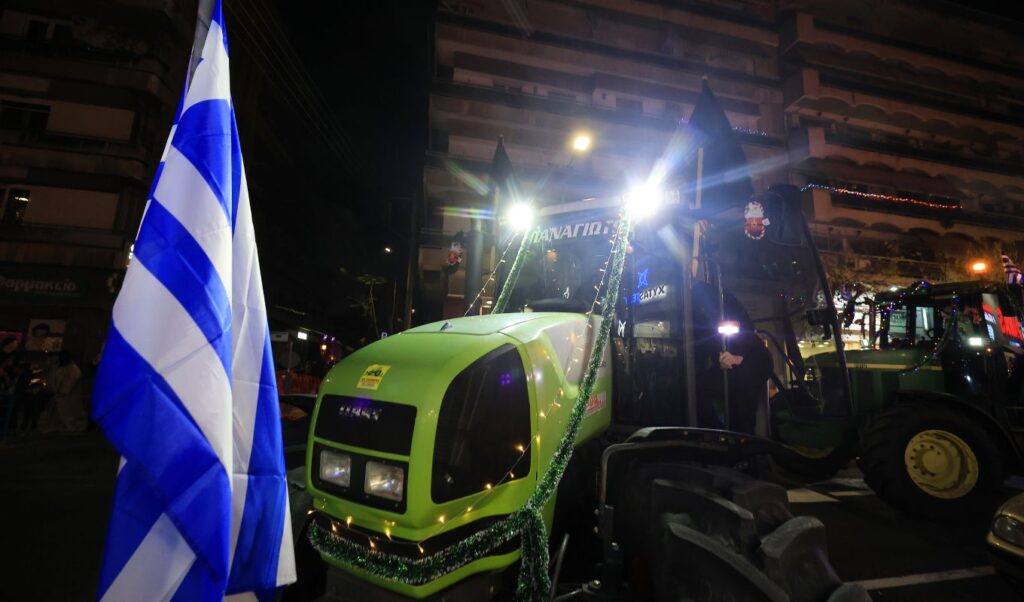
Farmer protests enter their third week today, with roadblocks on major highways at the forefront, as the government continues to seek de-escalation through dialogue, despite farmers’ refusal following their Saturday gathering in Nikaia, Larissa.
Kyriakos Mitsotakis, in his speech to the New Democracy Parliamentary Group on Friday, sent a specific message and invitation to the agricultural community: “On Monday afternoon, at 17:00, I will wait in my office for any delegation appointed to discuss, as we have done many times in the past,” the prime minister stated. Farmer representatives refused to attend the meeting, setting the condition that the government first guarantee satisfaction of their demands, which they presented in writing.
“Dialogue cannot happen with ultimatums. And solutions emerge only from discussion. Whoever rejects these principles of logic and Democracy assumes great responsibility toward the rest of society,” was Mitsotakis’ response through his customary Sunday Facebook post. “For my part, I repeat that the government’s door remains open to any farmers and livestock breeders who want to meet either with me or with Deputy Prime Minister Kostis Hatzidakis and Agriculture Minister Kostas Tsiaras,” he added, showing that the government insists on dialogue, aiming to provide the quickest possible solution to the apparent deadlock, so that tourism, commerce, and transportation can operate normally throughout the country during Christmas, New Year’s, and Epiphany holidays. This means farmers must gradually withdraw from roadblocks by the end of the week, an exercise that currently appears particularly difficult and complex.
Message from merchants, craftsmen and industrialists to farmers – “Refusal of institutional dialogue constitutes a choice of deadlock”
It’s worth noting that the Thessaloniki Chamber of Commerce and Industry (TCCI), Thessaloniki Chamber of Crafts (TCC), Association of Greek Industries (AGI) and Exporters Association (EA), in a joint statement, express deep concern “about the refusal of agricultural sector representatives to engage in dialogue with the country’s Prime Minister” and argue that “at a critical juncture for the Greek economy, refusing institutional dialogue is not a form of advocacy but a choice of deadlock.”
The path of discussion as a means of crisis resolution was once again favored by Kostas Tsiaras. “Dialogue is essential. Solutions are given when both sides sit at the table. Not with confrontations on national highways. I call on farmers to reconsider their stance, to take advantage of the opportunity to present their problems at the highest political level,” the Agriculture Minister emphasized speaking in Parliament.
Earlier, Tsiaras showed that after Saturday’s developments, the government now places responsibility on farmer representatives for the deadlock and absence of dialogue. “Farmers also assume responsibility for their own choice not to engage in dialogue. Who in a pretextual way attempts not to come to the discussion table is something judged by all Greek citizens,” he said, speaking on MEGA.
Measures being considered by the government for farmers
The prime minister simultaneously emphasized that “the government takes into account every fair demand” and that “it is already studying a package of additional support measures.” According to sources, these include for discussion – provided farmers come to the dialogue table – the following:
Extension of the “Gaia” program that ensures low electricity prices at 9.2 cents/kWh for farmers
Simplification of invoice payment procedures so farmers receive their money faster
Redetermination of fuel quantities eligible for tax refunds
Redistribution of money left over from farmers who are ultimately “cut” from comprehensive audits being conducted. “We will have an internal redistribution in favor of more honest declarations,” Hatzidakis characteristically noted.
However, farmers’ demand not to integrate OPEKEPE into AADE finds the government categorically opposed. “Non-negotiable, however, remains my position on OPEKEPE’s rehabilitation through its integration into AADE. This is because it’s the catalyst that will comprehensively modernize the country’s primary sector,” Mitsotakis emphasized, calling once again for farmers to open the roads.
“Roadblocks that effectively turn against other social groups do not serve farmers’ demands. On the contrary, they undermine them. While occupations of roads and other public infrastructure belonging to everyone are not responsible actions. But moves that harm the country. And, certainly, local economies in the periphery,” he noted in his post.