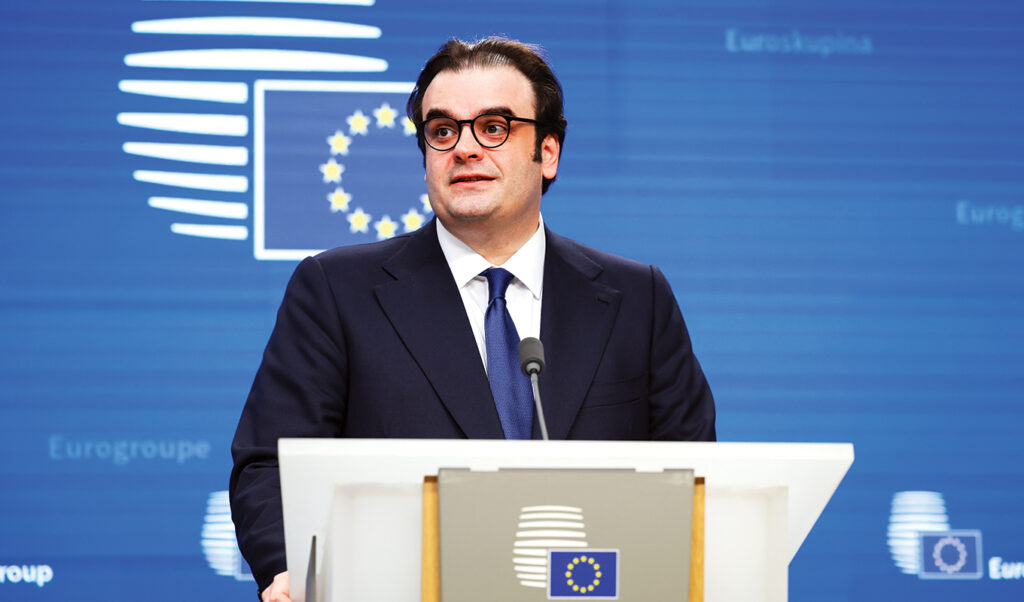
A significant boost to the government’s promotion of Greece’s so-called economic success story, both domestically and internationally, comes from the election of Kyriakos Pierrakakis – unanimously – to the presidency of the Eurogroup, a position he will hold until mid-2028. Exactly ten years after the effective expulsion of a Greek finance minister from a Eurogroup meeting, the election of the current Greek Finance Minister to the presidency of the body represents the European seal of approval and recognition of the positive trajectory of the Greek economy and the restoration of its credibility, following a multi-year debt crisis and three adjustment programs under three different governments. Many European governments and finance ministers wanted to highlight in this way the successful trajectory of the Greek economy, especially when they face criticism at home for public finances and the preparation of their 2026 national budgets, which often reaches or even exceeds the limits of populism.
Read: Person of the Week: The new Eurogroup president, Kyriakos Pierrakakis
In purely procedural terms, the vote took place on Thursday afternoon, among the 20 finance ministers of eurozone member states, chaired by Cyprus’s Finance Minister (as Cyprus takes over the six-month EU presidency in January), Makis Keravnos. This followed the departure on November 18 of Irishman Paschal Donohoe, after five years, from the Eurogroup presidency, to take up the position of deputy director of the World Bank. After intense consultations and behind-the-scenes negotiations, ultimately two finance ministers submitted candidacies for the succession: Kyriakos Pierrakakis and Belgian Budget and Administrative Simplification Minister Vincent Van Peteghem, who also belongs to the European People’s Party, thus dividing the European center-right.
However, after public support for Pierrakakis from the German finance minister on Thursday morning, Van Peteghem quietly withdrew his candidacy at the last minute. Van Peteghem’s candidacy had two significant advantages: he is simultaneously deputy prime minister of Belgium’s government, thus holding a high-level position, and comes from a large country and founding member of the European Union. However, he also had two significant disadvantages: first, his party, the Christian Democratic and Flemish Party (CD&V) is a minor partner in the coalition government, and second, in the dispute over utilizing frozen Russian assets, which many European countries are demanding, he is completely opposed (as is his government), since the vast majority of Russian money is located in Belgium, specifically at Euroclear Bank.
Pierrakakis’s campaign before his election to Eurogroup presidency
Mr. Pierrakakis, despite being only nine months in the position of Finance Minister, managed to build good personal relationships with several of his counterparts, while in the last ten days before the vote he conducted a personal campaign, visiting his counterparts in Dublin, Rome and Paris in sequence. Beyond the trajectory of the Greek economy, he also leveraged Greece’s successful digital transformation over the past four years under his previous role as Minister of Digital Governance, which was a significant asset at a time when discussion about the digital euro has matured in the eurozone. Since early December, both Prime Minister Kyriakos Mitsotakis and Foreign Minister Giorgos Gerapetritis have personally communicated with their counterparts in eurozone countries to support Pierrakakis’s candidacy, while the help of New Democracy’s International Relations Secretary, Tasos Chatzivasiliou, was also valuable.
Leveraging the country’s successful digital transformation over the past four years, he brings advantages to a eurozone preparing for the electronic issuance of the common currency
The duties of the Eurogroup president
Specifically, the president of the Eurogroup – a body created in 1997 – has the following duties:
- Chairs Eurogroup meetings and prepares agendas.
- Prepares the Eurogroup’s long-term work program.
- Presents the results of Eurogroup discussions to the public and to ministers from EU member states not in the euro area.
- Represents the Eurogroup in international forums (e.g., G7).
- Briefs the European Parliament on Eurogroup priorities. “This development, however, simultaneously represents the most emphatic recognition of our country’s positive trajectory. The strongest reminder that the struggles and perseverance of an entire people have been vindicated. And this, exactly one decade since the country found itself on the edge of the precipice, with closed banks and just before exit from the euro,” was Kyriakos Mitsotakis’s first statement, who added: “And yet, the former ‘black sheep’ from bankruptcy now rises to the top of the Economic Council of the continent’s most developed countries. And all this thanks to our citizens’ sacrifices.”
Published in Parapolitika