Kyriakos Pierrakakis spoke about sound strategies that generate growth and reforms that transform the country’s productive model, strengthening fiscal performance and essentially creating the next day after the expiration of the Recovery and Resilience Fund.
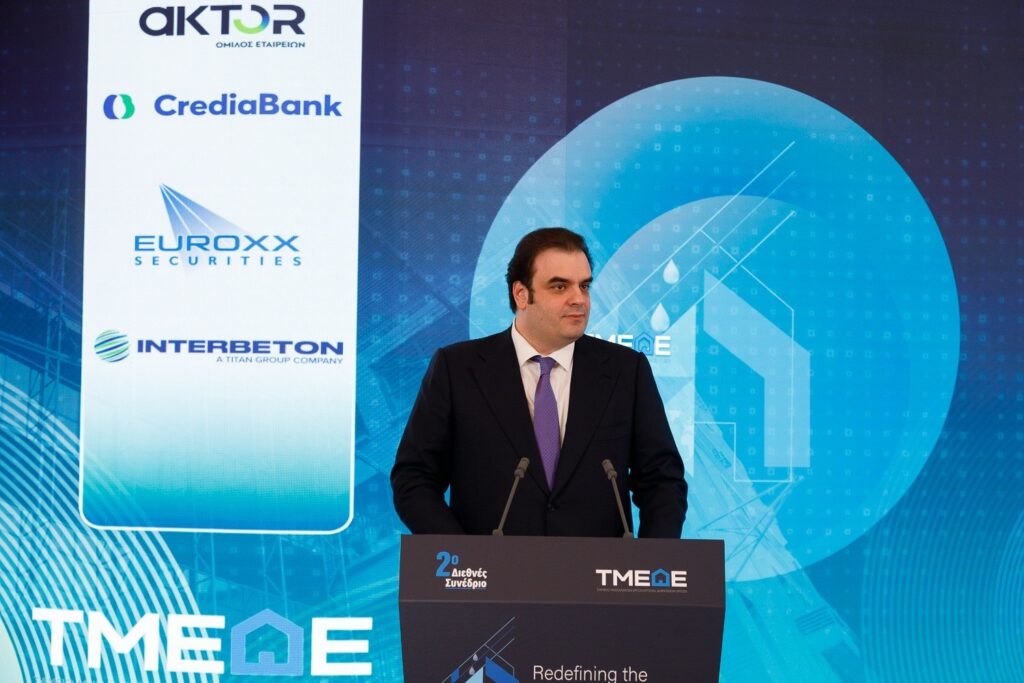
The Minister of National Economy and Finance spoke about tomorrow’s prospects while opening the second day of the 2nd International Conference “Redefining the Future Horizons: Designing Tomorrow’s Sustainable Strategies,” organized by the Engineers and Contractors of Public Works Fund (TMEDE) on December 9 and 10, at the Bank of Greece Employees Association building on Sina Street 16, Athens. The event is held under the auspices of the Bank of Greece and the Technical Chamber of Greece, confirming the high institutional significance and upgraded level of dialogue that TMEDE promotes in the critical field of sustainable development.
Pierrakakis: Investment attraction is our primary goal
According to the Minister, the goal is to attract investments, while describing the economy’s current state, he spoke of a very large economic transformation that has become an asset in recent years. “At this moment, Greece has one of the best fiscal performances in Europe,” he noted and emphasized the debt de-escalation at great speed, stressing that by the end of the decade the forecast is below 120%. “Our goal is very soon not to be the most over-indebted country in Europe in terms of debt-to-GDP ratio,” he noted. He characterized this goal as both feasible and deeply social.
“We have achieved fiscal balance, and simultaneously we have achieved a major digital transformation,” continued Mr. Pierrakakis, adding that one interacts with the other and cited tax evasion combat as an example.
The Minister made special reference to the “major reform process that has created a virtuous cycle.” He described it as a triangle that includes “at one end fiscal consolidation, at the other a banking system that is being rehabilitated, and third, reforms.” Specifically on reforms, he emphasized that over 100 have been implemented in the last 6 years in every policy sector, explaining that “digital transformation is the source of growth to manage to set a country upright.”
“We are on a positive trajectory,” Mr. Pierrakakis assessed, attributing the large debt generated in the pre-crisis years to the productive model, where now “change is happening there too, which has not been completed.” He indicatively emphasized that investments to GDP are today at 17.7% when in 2019 they were at 11%, acknowledging that there is still road ahead as the European average is at 21%, while the second element he mentioned was exports to GDP where today it is at 42%, double the percentage from 2008 with a European average today at 51%. “This is where our goal is founded, our goal is to bring more investments,” he added.
The strategy for the next day – After the Recovery and Resilience Fund
The Minister made special mention of the ongoing discussion about the next day, when the Recovery and Resilience Fund expires, recognizing the catalytic role it played in financing projects for which there were no funds. “We managed to cover the perimeter of the necessary and entered the sphere of the desirable,” he noted characteristically.
He focused mainly on the change that occurred regarding linking funds with reforms and the magnitude of impact they will have on the economy, commenting that the multiplier effect of the projects will have a longer duration.
“Money doesn’t exist, money is generated, growth is generated through sound strategies – and you leverage. And the broader European picture,” he emphasized. The issue the Minister raised is the impact that funds coming in the coming years through co-financed programs will have on the economy. He mentioned that what each government does matters and cited as an example the measures announced by the Prime Minister at the Thessaloniki Fair for demographics and tax reliefs that were announced. “Before the measure, the forecast for 2026 growth was 1.8%, as soon as we passed the measures, the forecast went to 2.4%.”
Continuing, Mr. Pierrakakis referred to the goal of pursuing cross-border mergers and acquisitions in the economy, invoking the Draghi report which notes that EU member states have invisible tariffs between them and calls for removing obstacles.
In this direction, the Minister mentioned Euronext and the acquisition of the Athens Stock Exchange that puts Greece in a broader network and generates greater liquidity possibilities. He also noted cross-border investments in banks as growth generators.
Summarizing, Mr. Pierrakakis mentioned that the goal is to continue changing the productive model with greater extroversion and leveraging funds in the logic of the RRF, connecting every euro with reforms and also for the country to pursue a very large rise in investments.
“The more we remove obstacles from the Greek economy, the more economic and political stability exists, you are in a virtuous cycle to be able to bring even more investments,” he emphasized and continued that “this is much more complete and more stable than anything else we had in the past as an alternative. The difference is that now we prove both to ourselves and internationally that we can achieve it.” He acknowledged that “there are still citizens being tested, bets that haven’t been won, families and businesses that need support, but simultaneously the change is very large compared to what preceded, so we must continue on this path and we will achieve much better things.”
The greeting of the Minister of National Economy and Finance Kyriakos Pierrakakis at the 2nd International Conference TMEDE “Redefining the future horizons”
It is a particular joy to be with you today.
Let me start by saying that I really like the conference title “Redefining the Future.” A good opportunity to take into account that construction, whether we speak literally or metaphorically about the future, is simultaneously art, science, innovation, faith and passion. I would say it is politics, because politics in a democracy is not exercised only by those who have institutional positions and institutional offices. In reality, we all exercise it and we all make a difference.
You invited me to speak about the Greek economy, what we have achieved, what are the change processes we are in, and where we want to go. I will try to codify this by focusing more on the following:
I think it is an asset that in recent years in Greece we have achieved a very large economic change, a very large economic transformation. You referred to the part concerning European institutions. I will tell you that 10 years ago, we all remember, Greece was ready to exit the euro.
At this moment we have one of the best fiscal performances in Europe. We managed to completely reverse the front pages of that era whether we talk about tax evasion, whether we talk about the deficits of that time, the debt that was growing.
At this moment we have debt that is de-escalating at tremendously high speed. Shortly after COVID-19 we had reached close to 210% of GDP in our debt. At this moment the forecast is that by the end of the decade we will be below 120%. The forecast for the 2026 budget is 138.2%.
Our goal is very soon not to be the most indebted, the most over-indebted country in terms of debt-to-GDP in the European Union. And this is a completely feasible goal and I will tell you it is also a deeply social and political goal. It establishes the conviction that you should not pass the bill to the next generation, as had happened with all previous ones in the past and we reached this point.
Simultaneously, Greece now produces primary surpluses, produces net surpluses. We have a growth rate that is greater than the European average. The budget forecast again is 2.4%, with the European average moving around the perimeter of 1%. So, we have achieved fiscal balance.
Simultaneously we have achieved a very large digital change. One interacts with the other. Because when we talk about tax evasion, a large part had to do with creating the AADE and institutionally armoring the tax collection mechanism, but on the other hand it had to do with the means you use to be able to collect these taxes. Technology plays a capital, a very large role here.
I would tell you, however, that we are also in a very large reform process that has created this virtuous cycle. I would put it as a triangle, which includes at one end this fiscal rehabilitation, at the other a banking system that is also being rehabilitated. We remember how many non-performing loans there were a few years ago and today they have fallen below 5% and are constantly falling.
And third, reforms. Over 100 reforms have been made in the last six years. I mentioned digital transformation which is a horizontal catalyst of many others, but I would tell you in every policy sector. And I put this because in reality this is the source of growth to be able to set a country upright, to make it stand upright. Whether we talk about Education, or Health, or we talk about the totality of state activities or we talk about Infrastructure. Because it is given that infrastructure in the economy has a very large multiplier both developmental and investment and regional.
Consequently, we are on a positive trajectory. I characteristically remember the publications of the pre-crisis era that talked about Greece’s economic model that had failed, that pushed us into crisis. Debt was one part of this equation. The question is how this debt was produced.
Very characteristically. Basic studies of that era said we have a very inward-looking economy based on consumption. We don’t export, we don’t have sufficient investments. Now we’re talking in 2008-2009 terms. The change there is now taking place. It hasn’t been completed, but it’s taking place.
I will mention two examples. The first example is the term investments to GDP, where investments in Greece are today and where they were in 2019 when we took over. In 2019 it was 11%. Today it is 17.7% based on next year’s forecast. The European average, however, is 21%. So we are on a trajectory of change, which still has not been fully completed.
Second, exports to GDP we were at 20% before the crisis, in 2008. Now we have doubled this, we are at 42% and there the European average is somewhere at 51%. So, I think that’s where the goal is founded. Our goal is to bring more and more investments.
In recent years we had very many projects also in the infrastructure space, which interests you a lot, projects that we had been discussing for many years and were constantly delayed, whether it’s the Patras-Pyrgos national road, whether it’s the Thessaloniki metro, or many others. All these happened also because of the funds that flowed in. And there has been generated lately especially, I would tell you, also a discussion about what after the Recovery Fund?
Because if one looks at the numbers indeed the Recovery Fund has played a catalytic role for us to be able to overcome the negative impact of the COVID-19 pandemic, it has played a catalytic role for us to be able to finance all those projects we had wanted to finance for years in Greece, whether they were digital or were in the classic infrastructure space and we simply didn’t have the funds. I remember being Minister of Digital Governance in 2019 when I had just taken over, we were making a strategy text called “Digital Bible,” mapping all the projects we needed and when we mapped them with my colleagues, before the Recovery Fund came, we concluded that we have at our disposal money to cover only 20% of the strategy. We didn’t have, that is, the money to implement the text we ourselves had prepared before the Recovery Fund came.
The Recovery Fund came, we managed to over-cover the perimeter of the necessary, we entered the sphere of the desirable with the money we had.
And at this moment when the Recovery Fund is being completed, the question arises: how will we have a development catalyst? I, therefore, here want to emphasize the following and say it somewhat schematically.
Money doesn’t exist – to remember a phrase from the previous decade – money is generated. Growth is generated, you generate it through your policy, through liberating growth, through making correct strategies, having multipliers for the things you choose to do and the goals you choose to invest in, and leveraging the broader European picture. Funds will come to the country through the programs of the next period.
Second, the Recovery Fund projects have the particularity that they are not simply money that came to the economy without having lasting impact. There was an architectural particularity in the Recovery Fund, which will now remain in all the next ESPAs, to put it that way.
It demanded for every euro invested in the country this to be combined with a reform. And with a broader plan. That is, don’t just put money there. Explain to me this money, in what broader puzzle it is placed and what kind of impact you expect to have on your economy. The multiplier effect of all these projects will be very large and much more lasting than the 2026-2027 timeline. But here, also, let me say that what each government does and what each architect of strategy, of the country’s economic policy, broadly, each team that manages, plays a very large role. Let me give you an example. The Thessaloniki measures, which the Prime Minister announced, the part that concerned tax system reform with emphasis on Demographics. Basically, the largest tax relief in terms of direct taxes ever made in Greece.
Before we made this measure, the forecast for 2026 growth was 1.8%.
As soon as we passed these measures as law by the Greek Parliament, immediately the forecast went to 2.4%. Plus 0.6%, that is.
I put this as the first example. The second example I will put is a Deloitte study that was given to me when I was Minister of Education, which said that the strategy concerning on one hand the internationalization of public universities and on the other the fact that Greece will acquire non-state universities, in relation to how many foreign students we can bring to Greece and their footprint, will give 1% of GDP over five years, on an annual basis.
I mention this as an example of thinking method, of how the economy must generate growth, leveraging all available funds and mainly pursuing even more cross-border mergers and acquisitions in the economy. What do I mean in relation to this?
At this moment in Europe, the very large discussion that exists has to do with the Draghi report and the Letta report, but mainly the Draghi report says what? That we haven’t leveraged the possibilities of the single market. We had a discussion with the US concerning tariffs that can be put on products and Mario Draghi concludes, utilizing, in fact, some numbers, some IMF calculations, that in reality EU member states are as if they have tariffs between them, invisible. Bureaucratic obstacles that don’t allow a Greek company to go to Italy, for example, and do something it does easily in Greece. 110% tariff is the equivalent that exists in services, 44% in manufacturing, the IMF concludes.
What is the conception here? Let’s remove obstacles to leverage the possibilities of the single market. So let’s generate scale, so let’s create European champions in the European economy that can compete internationally, to put it schematically. What does this mean? Let’s take as an example what we did.
Euronext came recently, made a proposal and will acquire the Athens Stock Exchange. Euronext already had presence in 7 countries. Greece, Athens becomes the eighth. And we enter a broader European liquidity environment that includes capitals like Paris, Oslo, Amsterdam. That is, listed companies in our stock exchange will in reality be listed in a network where one will simultaneously see all these cities. All these countries. This is to a large extent the meaning of the Savings and Investment Union, the Capital Markets Union, as we used to say, to generate liquidity and financing possibilities in your economy much larger and much better. Another such part is wanting to have cross-border investments in your banks. As we have already done. And we have accepted investors both in Greek banks and our own banks acquire banks abroad and invest in Europe. Both happen. All these together are growth generators.
So, to conclude. Our goal is to continue changing the country’s and economy’s productive model with