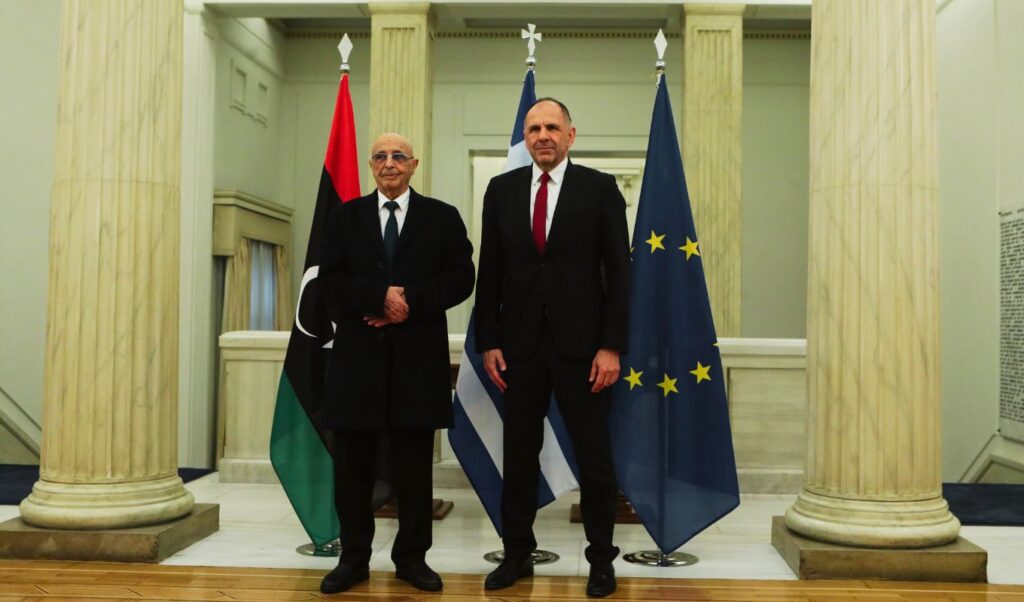
The visit to Athens by the president of Libya’s House of Representatives, Libya, Aguila Saleh, has caused significant turbulence. Both in Libya and in Ankara, supporters of the Turkish-Libyan memorandum reacted strongly to the talks that took place, speaking of “blatant Greek interference in Libya’s internal affairs.” The Libya Observer website published a statement from General Haftar’s government questioning “how can representatives of the Greek authority, whose decisions are subject to the will of donor and creditor countries and international financial institutions, dictate to the Libyan legislative authority not to ratify the Libyan-Turkish memorandum of understanding?”
The report further states that Haftar government spokesman Osama Hamad declared that Libya does not allow any external party to speak on its behalf or interfere in its legal and diplomatic choices that serve its people’s interests and guarantee their historic rights in the Eastern Mediterranean. On Sunday, the second deputy of the House of Representatives, Musbah Douma, who is in the opposing camp from Aguila Saleh, also made accusations of interference in Libya’s internal affairs.
Turkish media outlets reproduced the reactions in Libya, noting that “persisting in its maximalist demands, Athens has repeatedly claimed that the agreement is ‘invalid… non-existent’ and systematically pressures Libya to cancel it. Turkey is a key player in the region and seeks to expand its influence in Libya,” adding that Athens and Egypt allegedly pressured Haftar against the agreement.
Thrasyvulos Eftychidis to parapolitika.gr: Reactions in Libya originate from Turkey
International relations expert Thrasyvulos Eftychidis, speaking to parapolitika.gr, argues that the reactions in Libya originate from Turkey, as the alliance Erdogan has developed with Haftar, beyond that with the Tripoli government, resulted in creating a Turkish lobby within the House of Representatives. “The second Vice President of the House – who is among those in this Turkish lobby – made statements presumably at Ankara’s behest, so that Turkey could emerge today with publications, which we saw in Anadolu, Hurriyet and all the major newspapers, celebrating a national stance by Libya. I would say these statements have little significance, beyond the exploitation they offer Turkey. Greece’s Foreign Minister Giorgos Gerapetritis, as well as Parliament Speaker Nikitas Kaklamanis, reiterated the Greek position, which is also the European Union’s position, that the Turkish-Libyan memorandum is illegal and abusive and naturally calls on Saleh to tell Libya’s National Assembly to stop any discussion of legitimizing it and to reject it. On the other hand, we see that the Turkish lobby functioned in this way.”
Drilling operations key to EEZ determination
Meanwhile, Egypt is proceeding with talks with General Haftar and is in dialogue about determining EEZ boundaries. According to Mr. Eftychidis, the EEZ determination between Libya and Egypt is expected to practically affect both the Turkish-Libyan memorandum and the Greece-Libya EEZ when it emerges through talks in technical committees. However, he argues that “drilling operations currently taking place exactly at the boundaries of the Greece-Egypt-Libya EEZ are expected to play a decisive role. Their results are primarily what will influence any subsequent EEZ determination.”
Meanwhile, diplomatic sources speaking to parapolitika.gr maintained that in the meeting between the Foreign Minister and Aguila Saleh, Greece’s position was expressed, which is also the EU’s position that the Turkish-Libyan memorandum is invalid and non-existent. However, while the president of Libya’s parliament “did not appear negative toward Greece’s positions,” he expressed more concern about finding a solution to the political problem dividing his country, asking Athens, as a European Union member and non-permanent UN member, to contribute to organizing elections for forming a unified government.