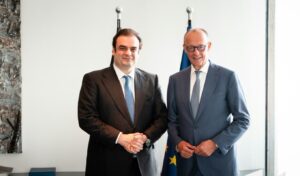
Having completed two decades as a Member of the European Parliament, Manfred Weber is today one of the most recognizable figures on the Brussels political scene. President of the European People’s Party and the EPP Parliamentary Group in the European Parliament, Manfred Weber recently visited Athens and spoke exclusively to “Parapolitika” about the Greek economy, developments in Ukraine, and Kyriakos Pierrakakis’ candidacy for the Eurogroup.
Nearly four years have passed since Russia invaded Ukraine. Do you support the peace plan being promoted by the US? How many concessions do you think Ukraine can make?
Everyone wants peace. First of all, the Ukrainians. And that’s why we’re working hard to achieve this peace. But I must say that the American plan, the 28-point plan, is not a real peace plan. It means Putin would achieve all his goals. And that’s not acceptable. The red lines are clear. Ukrainians will never give up free Ukrainian territory. Second is that a general amnesty for Russian war criminals is unthinkable. Remember the war crimes in Bucha. Justice must be served for Ukraine too. And third, Ukraine must be strengthened militarily, not weakened, because it constitutes the front line between Europe as a free, democratic continent and Putin’s authoritarian system. That’s why it must be given the ability to have a strong Ukrainian army. These are the three criteria we must uphold.
Where does the European Union stand in all this?
The EU was present in Geneva. You know the first draft was a shock. I have to be honest about this, because Europe wasn’t informed at all. Ukraine wasn’t informed at all. But we made it clear that none of this will happen without us. And that’s why you can’t make a deal without the European Union at the table. So Geneva was good. The talks were good. We’re now in a better situation. We must accept the new world we live in, with Donald Trump, with how the American government operates. This is the new reality. And this is a wake-up call for all of us, that Europe must speak with one voice.
The European Council is coming on December 18. The most difficult issue regarding the Ukrainian question concerns frozen Russian assets, which are mainly located in Belgium. What will be the outcome of the discussion?
For me it’s clear that the cost of this invasion, of Russia’s brutal terrorism in Ukraine, must be paid by Russia. That’s why the 200 billion euros of frozen Russian assets in Belgium must be used. Partially, we now need 140 billion euros to finance the Ukrainian state. And the message is clear: Russia must pay. Now we’re discussing how we’ll finance Ukraine so it can continue to function.
Two years after the Draghi and Letta reports, where is the European economy? Major states like Germany or France face budget problems.
I can only say: let us learn from Greece. You have a growth rate of 2.3% right now. Everyone sees Greece today as a winning country, as a symbol of future prospects, as a positive example for the future. All the administrative reforms, digitization, constitute a real model for many other countries. States like Germany and France can look to Greece and see how one can develop things in a positive direction. And this is the starting point: let’s proceed with reforms, let’s do things. What we’re doing in the European Parliament right now is healing some of the mistakes of the previous term with a more leftist majority, for example on the issue of excessive bureaucracy, burdens on our industry, or the internal combustion engine ban issue. We must not ban technologies in Europe. This destroys industries in Europe. And these are the issues we’re correcting right now. And then I would say: let’s believe in ourselves, because as Europeans we are 450 million consumers. We are a strong economic bloc in this world. If we further strengthen our single market, then we can have growth.
Let us learn from Greece. You have a growth rate of 2.3%. Everyone sees it today as a winning country, a symbol of future prospects, an example for the future
SAFE mechanism: Some leaders, like Kyriakos Mitsotakis, argue there should be a direct payment scheme, beyond loans.
Generally speaking, you know that for the first time in EU history, Europe as a whole is investing in military spending. This is a huge change and I want to go further. I believe we really need a European defense pillar. We need something like a European NATO, so we become independent. We want a strong relationship with America, there’s no doubt. But we see that Washington is no longer as clear as it was. And this means we must be ready to defend ourselves if necessary. Kyriakos Mitsotakis, together with Donald Tusk, proposed an “air shield,” that is, an anti-missile defense shield for the EU on its eastern side, on the borders with Turkey but also facing Belarus, to protect our eastern border. And this makes sense. But if we do this, it’s not just about the cost for the Greek taxpayer or the Polish taxpayer. It’s a matter for all Europeans to finance such investments on our eastern borders. This logic is needed now and that’s why we need the European Defense Pillar.
What is your view on Turkey’s participation in the SAFE program?
I am absolutely on Greece’s side. Greece gives us a clear picture that we have set certain criteria. If Turkey wants to participate, it must meet them.
You visited Athens and had dinner with Prime Minister Mitsotakis. What is your view on the state of the Greek economy right now?
First of all, Kyriakos Mitsotakis is a long-time friend and I truly admire what he’s doing here. I also respect, on the other hand, the efforts made by Greek society, because it wasn’t without cost. We must be honest about this. And I also very much like that strong economic growth is now combined with good social policy to support the most vulnerable. Both must coexist. Europe is at a crossroads, because in America we feel things are changing radically. I would say Europe is quite alone and we must recognize this. We can no longer rely on our strongest partner in America like in previous decades. And this turning point must lead us to conclude that it’s time to take the next step for Europe. And for me, again, this concerns foreign policy — look at the Middle East. Europe wasn’t really present during these periods of conflict. Same with defense issues: we need a stronger European voice.
Is Greek finance minister Kyriakos Pierrakakis a strong candidate for the Eurogroup presidency?
He is a strong candidate. And he can argue based on Greece’s great success. The fact that Greece, a former crisis country, is now in a position to be considered a possible head of the Eurogroup, is an excellent story. That’s why this candidacy is much appreciated. But the process continues.
You are a top figure of the center-right in Europe. Recent years have seen the rise of the far-right and related parties. And we continue to see this, because Marine Le Pen’s party is very strong; in the United Kingdom Nigel Farage seems to be leading for the next elections. What is your view?
Isn’t it crazy? Farage leading in polls now? He’s responsible for the labor shortage in the UK, because many Poles and others left the country after Brexit. What we must do as center-right is believe in ourselves. We are Europe’s largest party. We govern at national level. We govern at European level. We must solve problems. And we did. Migration, for example, is now being successfully addressed in Europe, because you in Greece are doing your job. In Italy they’re doing their job against Tunisia. We can stop illegal migration. This is the first thing we must talk about — success stories. And the second is to show leadership on big issues. So when in Germany the AfD or in France Le Pen tell citizens we don’t need the euro, we don’t need NATO, then we must stand up and say: this is nonsense. It’s not right. We need a strong European Union. And then citizens will decide: do you really believe what the populists tell you? Do you believe things will be better without Europe? And I think people know we need the EU, we need this unity. So being brave, defending our ideas strongly, this is what the EPP must do right now. And Greece shows we can be successful and we can show this at European level too.
There’s intense discussion in Greece these past days because former prime minister Tsipras published a book, something like an autobiography. How close did Greece really come ten years ago, in 2015, to leaving the Eurozone?
You know, the discussion ten years ago was very, very real; the threat was there. It was a chaotic situation, due to the Tsipras government. That’s why I find it quite ambitious that he now tells citizens he’s learned everything and would do things differently — but this is for the Greek people to decide. For us it’s not so important to compare ourselves with our competitors. The same applies at European level with socialists, liberals and others. What we must do is lead and give correct answers. And this isn’t easy, to be honest. It’s not an easy political landscape. But we must give correct answers and then people will respect leadership and we’ll have good results.