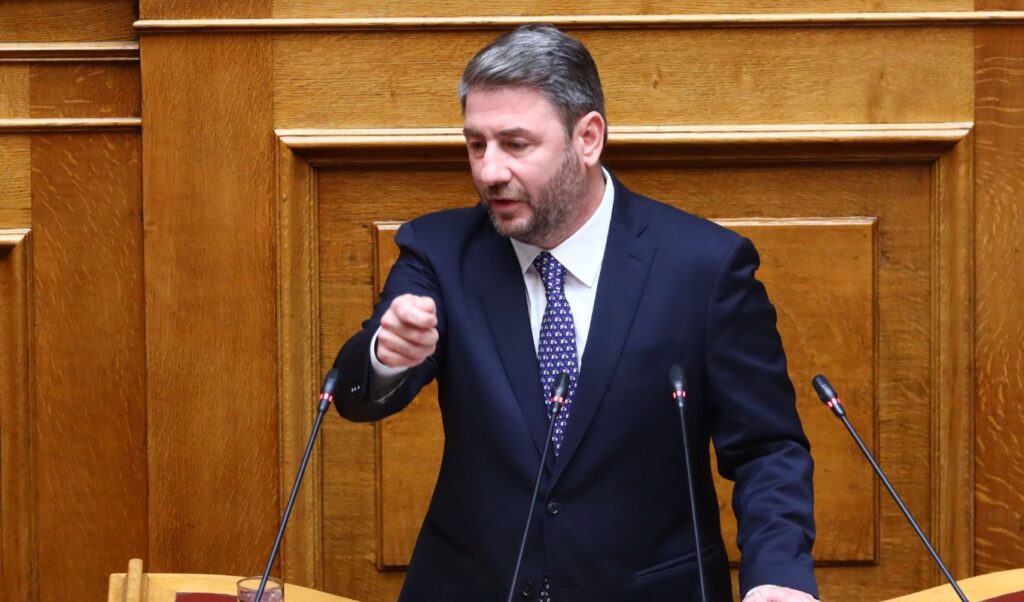
Many saw behind Nikos Androulakis’ initiative to reach out to the democratic opposition parties to seek consensus on revising the ministerial responsibility law his anxiety over Alexis Tsipras’ reappearance and the party formation that, as everything indicates, he will proceed with in the coming period. This is because, despite the fact that throughout the previous period SYRIZA was seeking cooperation with PASOK and New Left on all daily issues, as well as on “the government’s institutional inconsistencies,” Charilaou Trikoupi street appeared negative.
Those who support that behind Nikos Androulakis’ move lies Alexis Tsipras’ “Ithaca” and his potential new party note that the PASOK president obviously wants to make an institutional intervention just before Wednesday, as the former prime minister is expected in his speech to make harsh criticism of the government regarding its handling of institutional matters.
Androulakis’ double targeting
They believe, in other words, that with this move the leader of the main opposition attempts to do two things. First, to preempt Tsipras’ intervention and, second, to show that he too can unite all opposition parties that are within the democratic arc.
Koumoundourou, despite the rejections it has received from time to time, appears positive, as its officials have repeatedly argued that there must be changes and under no circumstances can this particular law continue in the form it has today.
At the same time, New Left also positions itself in favor of changing Article 86. In fact, sources from Alexis Charitsis’ party said they would enter this particular conversation within the framework of the overall dialogue that will concern constitutional revision.
Only KKE appeared critical towards Nikos Androulakis, emphasizing: “We remind the PASOK president, Mr. Androulakis, that the Communist Party of Greece in the last constitutional revision had proposed the complete abolition of Article 86 of the Constitution, so that all obstacles would be removed, so that ministers could be prosecuted like all citizens and their prosecution would not depend on the will of each parliamentary governmental majority, as happens today. Many of the ND government’s cover-up schemes would have been avoided if PASOK, like SYRIZA, had then supported KKE’s proposal.”
However, criticism regarding Alexis Tsipras’ book and the period of 2015 continues at the same pace. The PASOK president in his interview appeared particularly critical, saying: “I didn’t bring ND to 41%. Mr. Tsipras brought it there. We don’t have sponsors to play us day and night.”
Euclid Tsakalotos’ positioning on the former prime minister was in clearly milder tones: “If you don’t do a review of what went wrong and in opposition you fell from 31% to 18%, it’s a problem… I won’t go to the book presentation, nor do I see myself being in that scheme.”
But Stavros Theodorakis also mentioned: “We cannot be content with the fact that he simply presided over all those mistakes that were made in the country at that time. If he had done these things, probably a centrist world would have listened to him differently. Now I think he will be closed off to SYRIZA’s old audience.”